
DePIN meets the AI Demand Curve
Bubble or no, AI is already reshaping the traffic on our networks, the way our vehicles collect and use data, and the physical environments we move through. Every AI-enabled device sends more data than the device it replaced. Every vehicle equipped with cameras and AI features generates a stream of positioning and visual data that did not exist five years ago. That shift creates demand, and a subset of DePIN networks is positioned to capture it directly.
DePIN networks such as Helium, GEODNET, and NATIX work to support AI. Picture a single interaction. Someone asks their phone's AI assistant a question while walking down a crowded city block. The assistant needs a precise location to give a useful answer, so it pulls positioning data from a nearby GEODNET station instead of a satellite alone. The response generates a burst of uplink traffic that a Helium hotspot picks up and moves along, easing strain on the carrier network above it. Down the street, a car equipped with driver assistance cameras captures the same block in passing. That footage becomes training data for NATIX, feeding models that make the next generation of vehicles more capable of understanding streets.
Token prices across this sector have fallen well below their highs, and that decline sits alongside real growth in network usage for several of these protocols. Demand reaching a network is not the same as demand reaching the people who hold its token. Each network's tokenomics determines whether growing usage turns into value that flows to stakeholders, or leaks out through unlocks, subsidized pricing, or a burn mechanism that only returns part of what it takes in. Protocol performance across this group varies by stage, mechanism design, and disclosure quality, and each of those variables shapes how much of the demand story actually reaches a holder.
Hivemapper's burn returns only a portion of tokens to permanent supply removal. NATIX's burn draws from multiple fee sources, only part of which is protocol revenue. A network can show real usage growth and still carry a token that struggles to reflect it. GEODNET carries its own version of the same tension, where genuine revenue growth sits against a large token unlock schedule working in the opposite direction. Reading price alone answers neither question, which is why each section below separates the demand case from the tokenomics case explicitly.
Section 1 | Helium and the Uplink shift
Ericsson's June 2026 Mobility Report found mobile network data traffic grew 22% year over year in Q1 2026, exceeding its own forecast. Uplink traffic is now growing faster than downlink for the majority of operators measured. This shift ties largely to agentic AI workloads and AI-enabled devices, which send far more data than they receive. The report projects AI-driven uplink traffic reaching three times 2025 levels by 2031.
Helium gives carriers a way to add coverage and capacity without building it themselves. A carrier does not need to plan a tower site, secure permits, or commit capex to reach a new pocket of demand. It plugs into an existing network of independently deployed hotspots and pays only for the capacity it uses. Building out dense urban coverage from scratch is slow and expensive for any carrier, tower siting and permitting alone can take years in congested areas, which is why T-Mobile adopted Helium in 2022 and AT&T followed with its own agreement in 2025. Plugging into existing coverage is simply faster and cheaper than building new coverage, regardless of which carrier is doing the plugging.
What is not yet established
Neither carrier's public disclosures break out what share of its uplink or capacity needs is being met through Helium specifically, versus its own infrastructure. This section shows carrier-level adoption, not captured share of the traffic growth Ericsson describes.
A more fundamental question sits underneath both. The $0.50/GB rate carriers paid before June 2026 was a Nova Labs subsidy above prevailing market rates, not a reflection of what carrier offload actually costs. HIP-143 cut that rate to roughly $0.10/GB, an 80% reduction, to bring it in line with commercial terms and remove the subsidy. Carrier offload data volume grew about 20% quarter over quarter through the same window. An 80% price cut against 20% volume growth is not a break-even trade, and Q2 2026 protocol revenue fell 14% quarter over quarter as a result. Whether the network can grow volume enough to offset a repriced, unsubsidized rate, rather than relying on Nova Labs to prop up revenue at an above-market price, is the open question the rest of this section's thesis depends on.
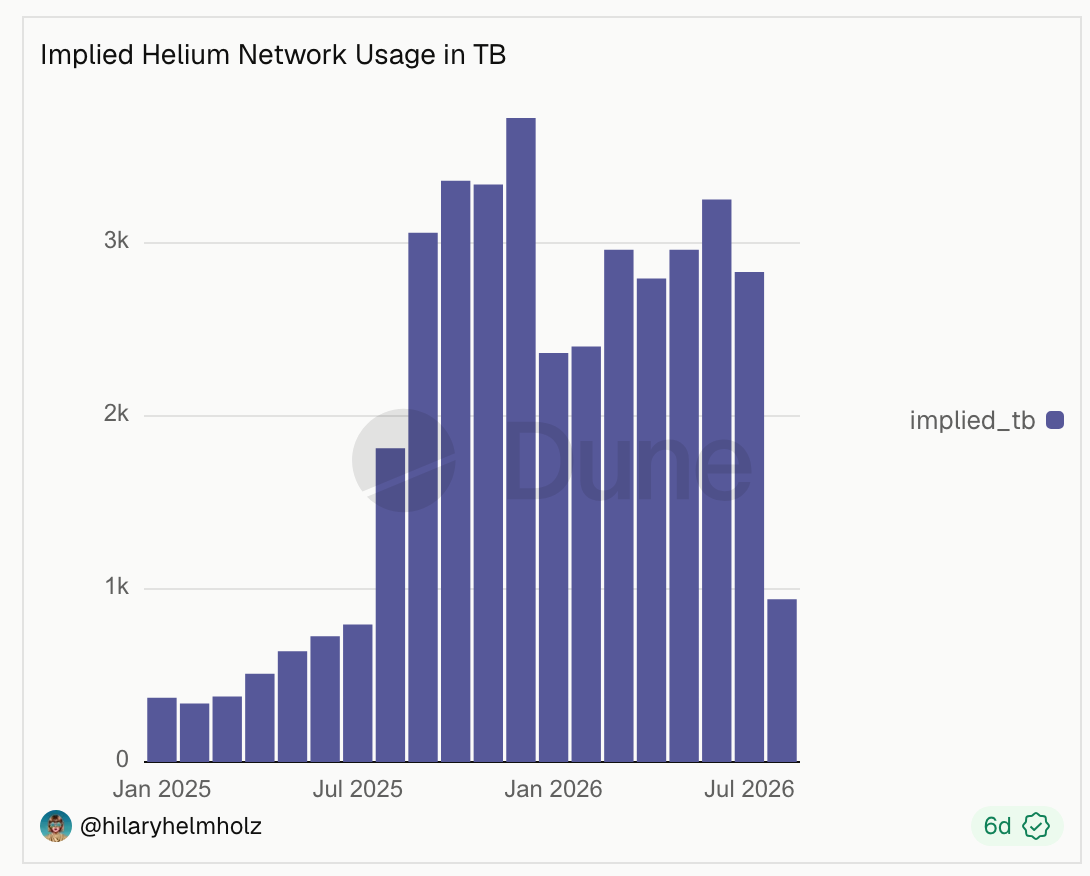
The test to watch
Carrier offload volume should grow fast enough to offset the 80% rate reduction and return protocol revenue to growth without a return to subsidized pricing. If volume growth continues to trail the size of the price cut, Helium's revenue model remains dependent on carriers paying above-market rates, which is the same subsidy the June 2026 repricing was meant to end.
See here for the full Helium Case Study and here for the HIP 149 update, which includes information about HIP 143.
Section 2 | GEODNET and the Positioning Requirement
Standard GPS places a device within two to five meters. Physical AI systems need centimeter-level accuracy to operate at all. GEODNET closes that gap by coordinating a global network of satellite reference stations rather than depending on satellite signal alone.
The network has scaled to more than 20,000 stations across over 150 countries, making it the largest RTK network by station count, ahead of centralized incumbents like Trimble. Trimble and Hexagon build proprietary hardware and sell subscriptions through multi-year enterprise contracts, a model that only pencils out in high-income, high-density markets. GEODNET runs as a data marketplace instead, with independent operators funding station deployment rather than GEODNET itself. That structure delivers RTK accuracy at a cost more than 90% lower than centralized deployment, and it lets GEODNET reach regions where a centralized network was never economical to build.
Agriculture is one potential market where that cost advantage opens the door to previously unreachable customers. Centimeter-level positioning enables autonomous equipment and precision farming techniques that were previously priced out of reach for farmers across much of the developing world. GEODNET's structural cost advantage puts that capability within reach, though the market remains unproven. (See our full GEODNET case study here)
Revenue has scaled alongside the network. Gross protocol revenue grew from $1.27 million in 2024 to $4.22 million in 2025, a 3.3x increase. July 2026 revenue alone annualizes to roughly $11.5 million, and if that pace holds through the rest of the year, 2026 would mark a second consecutive year of revenue more than doubling. (Defillama)
The network counts Quectel, DroneDeploy, Propeller, USDA, HemisphereGNSS, and Septentrio among its customers, and revenue comes from recurring enterprise subscriptions rather than one-time transactions. A reseller API launched in the third quarter of 2025 turned OEM partners into distribution channels, letting each partner activate its own downstream install base without direct sales effort from GEODNET.
That customer list spans both sides of the thesis this piece is testing. Quectel and Septentrio sit closer to automotive and robotics. USDA and HemisphereGNSS sit closer to agriculture and survey, the market GEODNET served before physical AI existed as a category. Revenue is not broken out by segment, so the list demonstrates breadth rather than which vertical is driving growth.
What is not yet established
Revenue is not disclosed by vertical, so whether robotics and automotive demand is a growing share of the business cannot be confirmed from the customer list alone. Whether GEODNET's cost advantage has yet converted into actual adoption among developing-world agricultural operators, versus remaining a theoretical addressable market, is also unconfirmed. GEODNET's hardware is manufactured by HYFIX and Rock Robotics, and HYFIX was co-founded by GEODNET's own leadership. Evidence drawn from HYFIX activity carries a related-party caveat that limits its value as independent market validation.
The test to watch
Robotics and automotive should show up as a rising share of disclosed or inferable GEODNET revenue over time. A flat or shrinking share would undercut the thesis regardless of how many customer names are added to the list.
Section 3 | Mapping Data and the Physical AI Opportunity
Two networks are building competing bets on the same underlying shift. NATIX and Hivemapper both crowdsource street-level camera data from contributors, and both tie token value to actual usage through a revenue-funded buyback and burn rather than emissions alone. Hivemapper built its network first for freshness and coverage, mapping roads faster and cheaper than centralized incumbents, and has since added a training game designed to help its own map AI recognize objects in captured imagery. (See full Hivemapper case study here) NATIX has repositioned entirely around AI. Its original smartphone product, Drive&, sunset on July 1, 2026, in favor of VX360, which pulls multi-camera footage directly from Tesla's onboard cameras and feeds it into physical AI and autonomous driving model training through named partnerships with Valeo and the Autoware Foundation (NATIX).
Hivemapper reported $421,000 in revenue for full-year 2025, and $180,000 for the first seven months of 2026 (DefiLlama). NATIX does not disclose revenue, making comparisons difficult. The protocol reports over 359 million tokens burned in the last 12 months (Dune) compared to Hivemapper’s 101 million tokens (Dune). This is not an apples to apples comparison. NATIX batches token burns quarterly and it directs a lower percentage of revenue to token burns.
What is not yet established
The two burn mechanisms are not equivalent. Hivemapper permanently destroys 75% of tokens burned through map purchases, with the remaining 25% recycled back into a new contributor rewards pool rather than leaving circulation. NATIX directs 40% of protocol revenue to buyback and burn under its own whitepaper, with 35% to staking rewards and 25% to R&D, and its burn reporting also folds in Drive& withdrawal and unstaking fees alongside that revenue share, so the total burn figure blends multiple funding sources rather than reflecting protocol revenue alone (NATIX). Hivemapper's revenue is also small relative to its own emission schedule, with contributor rewards still minting for years at the network's current pace. NATIX's circulating supply sits near 40% of its maximum, so its burns are working against a token that is still less than half minted, and the split between AI-driven revenue and fee-based burns from staking and unstaking remains undisclosed. VX360 has only been live for a matter of months since Drive&'s sunset, so there is no meaningful post-transition track record yet.
Both tokens have performed poorly; weak price alone does not establish which mechanism is failing. Supply overhang from unlocks and ongoing emissions can suppress price even where revenue is real and growing. Product-market fit for AI-driven demand specifically is still being tested for both networks. Neither has disclosed the segment of revenue directly attributable to AI training or licensing customers, so whether AI demand is what closes the gap between burn and emissions, for either protocol, is not yet answerable from what's public.
Names to watch
A third entrant is building toward the same thesis without a live token yet. Vangrid raised $9 million in seed funding, closing in tranches from August 2025 through January 2026, from investors including HashKey, Borderless Capital, Crypto.com Capital, Animoca Brands, Gate Labs, and Mapleblock Capital. It pays contributors to capture spatial data on smartphones, verified on-chain through the Ethereum Attestation Service on Base, and reports close to 100,000 verified captures on its public explorer. A token is planned for later in 2026, with reward mechanics to be announced closer to launch (The Block). Without a live token or disclosed emissions, Vangrid cannot yet be measured against the same burn-versus-issuance framework applied to NATIX and Hivemapper.
The test to watch
Hivemapper's revenue should grow materially as AI-relevant products scale, and its permanent burn share should be tracked against its own emission schedule to see whether the gap between issuance and destruction is closing. NATIX's monthly burn attributable to disclosed AI protocol revenue, separate from fee-based burns, should grow now that VX360 has replaced Drive& as the network's primary product. If neither shows revenue closing the gap with emissions within the next several quarters, the physical AI mapping thesis remains unproven for both networks. Vangrid's own trip-wire remains conditional: once its token terms are announced, its emissions and reward mechanics should be checked against disclosed or inferable revenue before it earns a scored assessment of its own.
Section 4 | Honorable Mention to DIMO and the Vehicle Data Layer
DIMO streams vehicle telemetry, location, diagnostics, and battery data through an API, and has repositioned that data specifically for AI use. Its platform now advertises normalized, AI-ready data feeds and a dedicated Agents API, a shift from its original pitch centered on driver data monetization. Fees for data access convert into credits, a portion of which the protocol burns monthly, with the remainder distributed to the nodes supplying the data (Dimo).
DIMO's advantage sits in speed. Automakers have historically moved slowly on software and have been reluctant to commit capital to tech layers that sit outside their core manufacturing business. DIMO can ship a data and AI product layer across a fleet of connected vehicles far faster than any single manufacturer building the same capability internally, because it is not carrying that capital allocation problem (Dimo).
Two of DIMO's four co-founders, Rob Solomon and Alex Rawitz, have stepped away from the company, with co-founder and former CTO Yevgeny Khessin now serving as CEO (LinkedIn). That leadership transition adds execution risk on top of the disclosure gap, at a company whose product direction depends on shipping the AI-facing roadmap it has laid out. DIMO's speed advantage remains a structural argument rather than a measured one.
Section 5 | Where Demand Meets Token Structure
The demand holds regardless of any single network's tokenomics. Uplink traffic is growing, positioning accuracy is becoming a requirement rather than a nice-to-have, and vehicles are generating more visual data every year. What separates these networks is not whether that demand exists but whether each one's token design converts it into value that reaches holders rather than leaking out through unlocks, subsidized pricing, or a burn mechanism that only returns part of what it takes in.
That separation shows up differently at each stage. Helium is repricing an established network and has to prove volume can outrun the subsidy it just removed. GEODNET is scaling real revenue against a supply schedule working against it. NATIX and Hivemapper are both mid-transition, but on very different clocks. Hivemapper has years of disclosed revenue behind it, while NATIX only sunset its original product in July 2026 and has weeks of data on its replacement. Both are betting on AI-specific products before the burn mechanics behind either token have been tested against a full cycle of that demand.
None of that resolves into a single verdict for the sector. It resolves into a set of specific, checkable questions as laid out in each section. Tracking the thesis in comparison to the token price will show whether AI-driven demand actually reaches the token holders of each network or if it gets absorbed by the mechanics standing between usage and value.
