
CREDIT MEMORANDUM: DAWN Protocol / Andrena
USD.infra Vault | USD.infra & sUSD.infra Token Offering
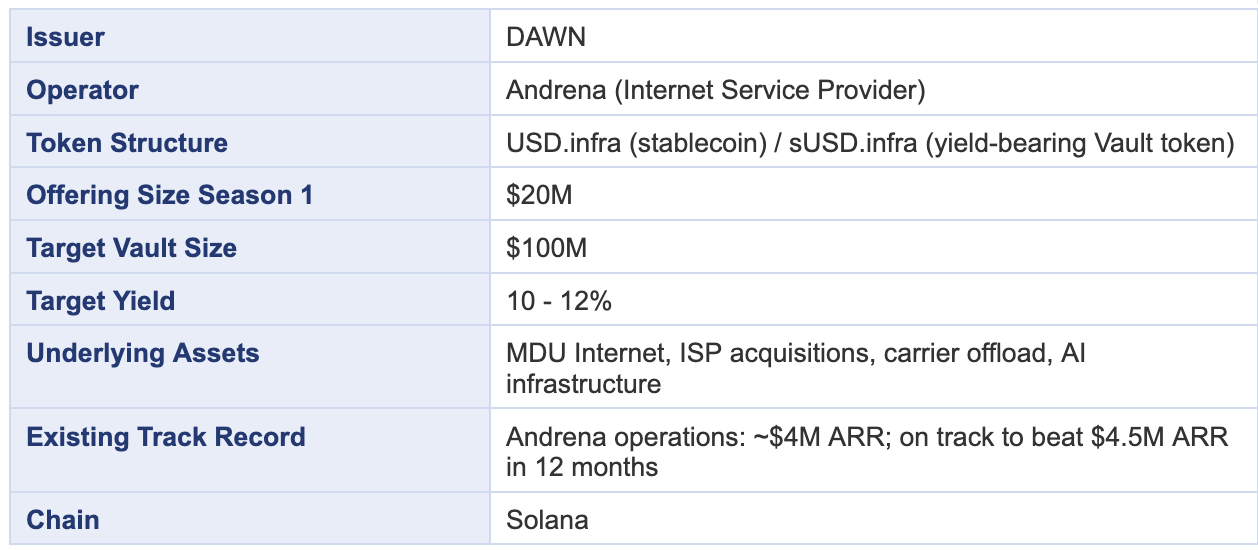
Transaction Summary
I. Executive Summary
1.1 Transaction Overview
DAWN has built an on-chain financing structure in which interest-bearing stablecoins are backed by digital infrastructure powering AI. This memo will specifically focus on the connectivity core of the USD.infra Vault, investigating the MDU Internet, ISP M&A, and carrier offload opportunities.
Depositors fund the Vault through USD.infra, a dollar-pegged stablecoin backed 1:1 by U.S. Treasury instruments, and receive sUSD.infra in return. These assets are held in bankruptcy-remote SPVs; Andrena, the initial primary operator partner, shoulders the operational risk and pays the Vault a contracted rate of return, which accrues to sUSD.infra holders through fair market value appreciation. A liquidity sleeve of 30–50% of TVL is maintained at all times, providing token holders with redemption capacity without touching deployed assets.
The structure addresses a specific and growing demand condition in crypto capital markets. Institutional and retail participants holding digital assets have historically faced a constrained choice: accept the volatility of token-denominated yield products, which move with market sentiment and funding rates, or hold stablecoins in money market instruments earning a rate that approximates the risk-free baseline. Neither option provides durable yield that is insulated from crypto market cycles. Digital infrastructure cash flows are generated by subscriber payments, carrier agreements, and long-duration building contracts, none of which are sensitive to the price of Bitcoin, the level of DeFi activity, or conditions in digital asset funding markets. The contracted, utility-like nature of those cash flows is precisely what makes them attractive to capital that is already on-chain and seeking a return profile that does not add to its existing crypto exposure. The USD.infra Vault is designed to make that yield accessible without requiring investors to exit the on-chain ecosystem.
II. Market Context – Connectivity
2.1 The Broadband Market Today
American broadband was built on a structural premise that has never changed: incumbent carriers own the infrastructure and have exercised that advantage for decades with minimal competitive check. Rather than correcting market concentration, recent consolidation has deepened it. Charter Communications' $34.5 billion acquisition of Cox Enterprises, approved by the FCC in early 2026, combines Charter's 31.2 million broadband customers with Cox's 6.5 million. The resulting entity is the nation's largest cable and broadband provider with approximately 38 million total subscribers (Reuters). This followed Verizon's $20 billion acquisition of Frontier Communications in January 2025, expanding its fiber network to 30 million homes across 31 states (Verizon). As capital and attention consolidate further around large-footprint national networks, the segments least attractive to incumbent carriers are multi-dwelling units.
The MDU Gap: 44 Million Americans, Largely Unserved
The problem is particularly acute in multi-dwelling units (MDUs), apartment buildings, condominiums, and affordable housing complexes, where residents face structural connectivity disadvantages that policy and private capital have been slow to address.
Approximately 44 million Americans live in multi-family units in the U.S., spanning roughly 25 million units in buildings with five or more dwellings, yet only about 17% of the total MDU stock currently has any form of bulk Internet arrangement. Notably 67% of multi-family housing buildings in the U.S. were constructed before 1980, meaning they were not designed with modern connectivity in mind. (Broadband Breakfast)
The barriers are not only technical. MDUs are often classified as "served" in federal broadband maps even when residents lack in-unit connectivity. This misclassification limits access to public funding and obscures the true scale of the problem. Exclusive provider agreements, fragmented building ownership, and aging inside wiring compound the challenge. Consumers report that connectivity has become the number one amenity in multi-family housing. Despite this, the economics of deploying competitive service in older MDU stock remain structurally unattractive to large carriers. (Broadband Breakfast)
This is precisely the gap that Andrena's wholesale MDU model addresses. By contracting directly with building owners under 7–12 year agreements and delivering broadband on a wholesale or passthrough basis, Andrena bypasses the legacy carrier dynamic entirely, creating a durable revenue stream underpinned by long-term property-level contracts rather than consumer churn.
2.2 The Wireless Revolution
The Technology Shift: Wireless as an Infrastructure Primitive
For most of the history of the broadband industry, deploying connectivity requires large capital outlays, civil engineering expertise, permitting processes spanning months, and labor-intensive installation. The emergence of 5G, fixed wireless access (FWA), and low-earth-orbit (LEO) satellite has fundamentally restructured that equation, reducing both the cost and the operational complexity of serving locations the legacy carriers have left behind.
The contrast with fiber is instructive as a baseline. Typical per-household fiber deployment costs vary from approximately $800 in dense urban neighborhoods to $6,000 or more in rural areas — driven primarily by the civil work required to install conduit, pull fiber-optic cabling, splice, terminate, and run a physical connection to each household. Fiber deployment costs rose further in 2024, due to increased labor and material expenses, with the majority of operators expecting costs to continue rising into 2025. Wireless eliminates this cost driver at the last mile entirely. With fixed wireless, there are no wires between the tower or small cell and the household, removing the costs associated with trenching, conduit installation, and overhead cabling to individual premises. (Wireless Infrastructure Association)
The scale of adoption reflects a market increasingly orienting around this cost advantage. According to the Ericsson Mobility Report, 81% of studied service providers globally now have an FWA offering, with 65% delivering it over 5G, up from 37% in 2022. FWA connections are forecast to grow from 185 million at the end of 2025 to 350 million by end of 2031. In the U.S., the three largest service providers achieved all-time-high quarterly FWA net additions of 1.04 million connections in Q3 2025, bringing their combined user base to 14.6 million connections. (Ericsson)
Critically for the MDU and commercial real estate context, advances in indoor CPE hardware have extended wireless deployment into environments that previously required wired infrastructure. Indoor CPE now accounts for the majority of FWA installations, with self-install kits designed to avoid technician visits resulting in accelerated adoption. This shift from civil engineering to plug-and-play hardware changes who can deploy connectivity and at what scale. Where legacy broadband required telco-grade operational infrastructure, modern wireless deployments can be executed at the building or campus level by operators without deep network engineering resources. (GSA)
This is the technological foundation that makes Andrena's micro-deployment model viable. Each MDU contract, or carrier offload installation represents a discrete, self-contained buildout with defined economics and a contracted revenue counterparty. This represents a structural shift from the large-footprint, long-lead-time builds that legacy underwriting was designed to evaluate. The DAWN hardware and software stack extends this further, enabling automated provisioning, network management, and monetization of connectivity across a distributed portfolio of deployment, replacing what would otherwise require dedicated operational staff at each site with a centralized, software-managed platform. The result is a model where capital efficiency scales with the number of deployments rather than with the size of any individual one.
2.3 The Capital Market Gap
The Capital Markets Mismatch: Where Off-Chain Constraints Meet On-Chain Demand
The financing gap identified in the previous section is not simply a matter of lender appetite. It reflects a structural mismatch between the characteristics of telecom infrastructure assets and the underwriting models of traditional capital markets. The assets themselves are not the problem. Individual deployments are too small for infrastructure funds and too operationally niche for generalist bank credit committees, whose underwriting frameworks are calibrated to EBITDA multiples and balance sheet ratios rather than subscriber counts, ARPU, and contract tenure. The implementation of Basel III in the U.S. remains in the final stages of rulemaking, with a revised proposal issued in March 2026 and final rules anticipated later this year. Its effects on bank lending behavior are already observable, with measurable pullback in appetite for niche credit sectors preceding formal implementation. Several large regional banks have exited middle market lending entirely since 2024, redirecting balance sheet capacity toward investment grade relationships and fee based advisory mandates. Morgan Stanley projects private credit assets under management will grow from approximately $1.7 trillion in 2024 to $2.8 trillion by 2028, with the bank to private credit migration representing a significant share of incremental flows (abf journal). For digital infrastructure specifically, this constraint is compounded by nontraditional credit metrics that neither bank credit committees nor the largest private credit investors are equipped to underwrite. The segment remains structurally undercapitalized relative to its underlying credit quality. For regional ISPs and MDU operators, the practical consequence is a market where capital is scarce, underwriting timelines are long, and financing terms reflect a liquidity premium that has nothing to do with underlying credit quality.
On-chain capital markets present a structurally complementary solution. Tokenized real-world assets tripled from approximately $5.5 billion to roughly $18.6 billion over the course of 2025 according to RWA.xyz data. Analysts project the market could reach approximately $2 trillion by 2030 (The Defiant). This growth reflects a specific and documented demand dynamic: crypto-native capital seeking yield that is durable, dollar-denominated, and uncorrelated with the volatility of digital asset markets. McKinsey & Company projects tokenized financial assets could reach approximately $2 to $3 trillion by 2030, with loans and securitization identified as among the leading asset classes for on-chain deployment in the first wave of institutional adoption (McKinsey & Company). The demand is structural vs speculative. As base DeFi yields have compressed with broader market cycles, the premium commanded by real-world cash flows has become a primary allocator of on-chain capital.
The USD.infra Vault is purpose-built to close the capital market gap. USDC deposited by investors converts to USD.infra, a telecom-native stablecoin backed by M0's T-bill infrastructure, and is deployed into bankruptcy-remote SPVs that fund Andrena's MDU contracts, carrier offload installations, and ISP acquisitions. Interest payments flow back through the SPV and accrue to the Vault, increasing the fair market value and exchange rate of sUSD.infra, the liquid yield-bearing receipt token representing each investor's position. The result is a product that delivers what on-chain capital has been seeking: contracted, recurring, real-world yield that is structurally uncorrelated to crypto market cycles, wrapped in a composable DeFi primitive that can be integrated across the broader ecosystem.
2.4 The USD.infra Opportunity
USD.infra as an Asset Class: Telecom as the Third Pillar of Digital Infrastructure
The tokenization of real-world infrastructure cash flows has established itself as a credible on-chain asset class. Two verticals have led the way. In compute infrastructure, USD.AI issues loans to AI firms using GPU hardware as collateral, with GPUs generating revenue by selling compute time for model training and inference and those cash flows servicing the debt that funds them. As of late April 2026, USD.AI reports approximately $280 million in TVL and $60 million in active loans (Coindesk). In energy infrastructure, Daylight raised $75 million in October 2025, comprising $15 million in equity led by Framework Ventures with participation from a16z crypto and others, alongside a $60 million project development facility led by Turtle Hill Capital, to connect DeFi capital with residential solar and storage assets generating contracted electricity revenues (Businesswire).
Telecom connectivity is the third pillar of this stack. It is the one that has, until now, lacked a credible on-chain capital formation vehicle. Communications infrastructure underpins modern economies in the same way compute and energy do. The ongoing wireless revolution driven by LEO satellite, fixed wireless, and 5G has fundamentally expanded who can deploy that infrastructure and at what cost. What has lagged is the financing layer to match.
Andrena's three-asset strategy is designed to capture value at distinct points along the wireless connectivity value chain, rather than concentrating exposure in a single segment.
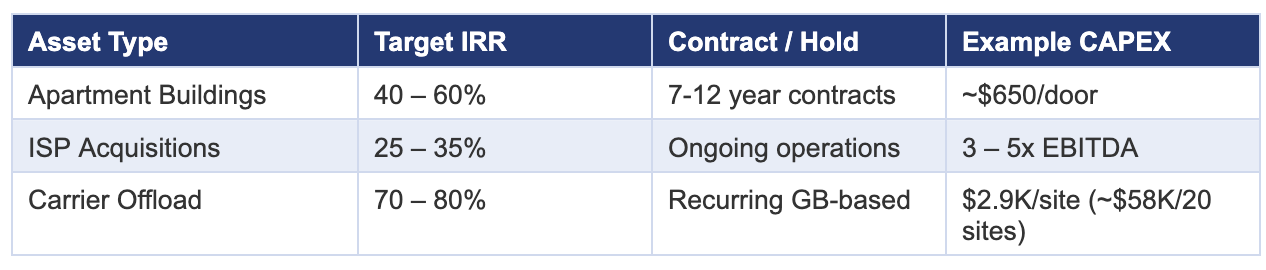
The first asset type is apartment building wholesale agreements, which operate at the access layer. Andrena owns the last-mile infrastructure connecting residents to the Internet, contracting directly with building owners on 7-12 year terms and earning recurring per-unit revenue regardless of which carrier or technology provides the upstream feed.
The second asset type is ISP acquisitions, which move up the stack into network operations. These transactions capture the aggregation and routing layer, where subscriber relationships, backhaul contracts, and operational scale generate EBITDA that Andrena can enhance through consolidation synergies. Acquisitions are priced at 3 to 5 times EBITDA, with post-acquisition synergies providing an effective discount to entry.
The third asset type is carrier offload, which operates at the traffic management layer. Andrena's deployed WiFi infrastructure becomes a relief valve for national telecom networks, earning per-gigabyte revenue as mobile data demand continues to grow.
The result is a portfolio diversified not simply by asset type but by function within the network. Each segment responds to different demand drivers and is not correlated to a single point of failure in the wireless ecosystem. Together, they represent a cash flow profile that is contracted, recurring, and structurally insulated from the volatility that characterizes most on-chain yield products.
III. Issuer and Operator Overview
3.1 Andrena (Operating Company)
Founded in 2016 and headquartered in Newark, NJ, Andrena, Inc. is a fixed wireless Internet Service Provider operating across 10 U.S. states, with active deployments spanning the multi-dwelling unit (MDU) broadband, sub-scale ISP acquisitions, and carrier offload segments. The company's core go-to-market model targets multi-family residential properties, offering building owners a complimentary connectivity foundation for common areas and operational use, while residents opt into affordable in-unit broadband service. Andrena's network architecture blankets entire multi-dwelling units with a broadband signal, eliminating the need for unit-by-unit hardware installation and enabling new subscribers to activate service immediately upon move-in. The company currently generates approximately $4M in annual recurring revenue across its existing operations, serving over 15k active subscribers and covering more than 32k households.
Andrena's infrastructure also serves as a hosting platform for carrier offload deployments, through which third-party network operators leverage Andrena's installed backhaul and power systems to extend wireless coverage. The company has expanded its institutional client base beyond residential properties to include large mixed-use developments and hospital systems, deploying dedicated Internet, managed WiFi, and Private LTE services across its footprint. As an operating entity within the USD.infra Vault structure, Andrena functions as both service provider and capital deployer, executing deployment activity through an SPV structure funded by the Vault.
3.2 DAWN
DAWN is a real-world asset protocol for digital infrastructure powering AI. Put another way, DAWN is an on-chain infrastructure financing layer purpose-built to connect real-world telecommunications assets to global capital markets. The protocol addresses a structural gap in the telecom industry. Wireless infrastructure has dramatically lowered the cost and complexity of building networks, expanding who can deploy and where. However, the financing systems that fund telecom remain in the past favoring large, centralized projects. Capital for smaller distributed, high ROI microdeployments is limited and expensive. Concurrently, on-chain capital is actively seeking uncorrelated, real-economy yield. DAWN sits at that intersection.
The protocol is operator-agnostic. Season 1 is anchored by Andrena, a licensed ISP with a live operating track record across all three asset categories, and the architecture is built to onboard additional telecom operators over time. Any qualified operator can access the Vault as a financing source, subject to protocol underwriting standards and capital committee approval.
The technical architecture governing capital flows, fair market value methodology, and oracle infrastructure is described in Section 5.
Vault Architecture
Capital flows into the USD.infra Vault, which deploys funds to operators through non-recourse loans secured against SPV cash flows, underlying contracts, and hard assets. Each deployment is ring-fenced within a bankruptcy-remote Special Purpose Vehicle, legally isolating individual asset cash flows from operator corporate risk and cross-asset contagion. A liquidity buffer is maintained at all times, ensuring a portion of TVL remains redeemable without touching deployed assets.
Operators deploy capital into infrastructure assets via the SPV. As subscriber revenue is paid, it is verified by a third party review and attested on-chain via Chainlink. Accrued interest is reflected in Vault fair market value, increasing the value of the yield-bearing Vault token for all participants.
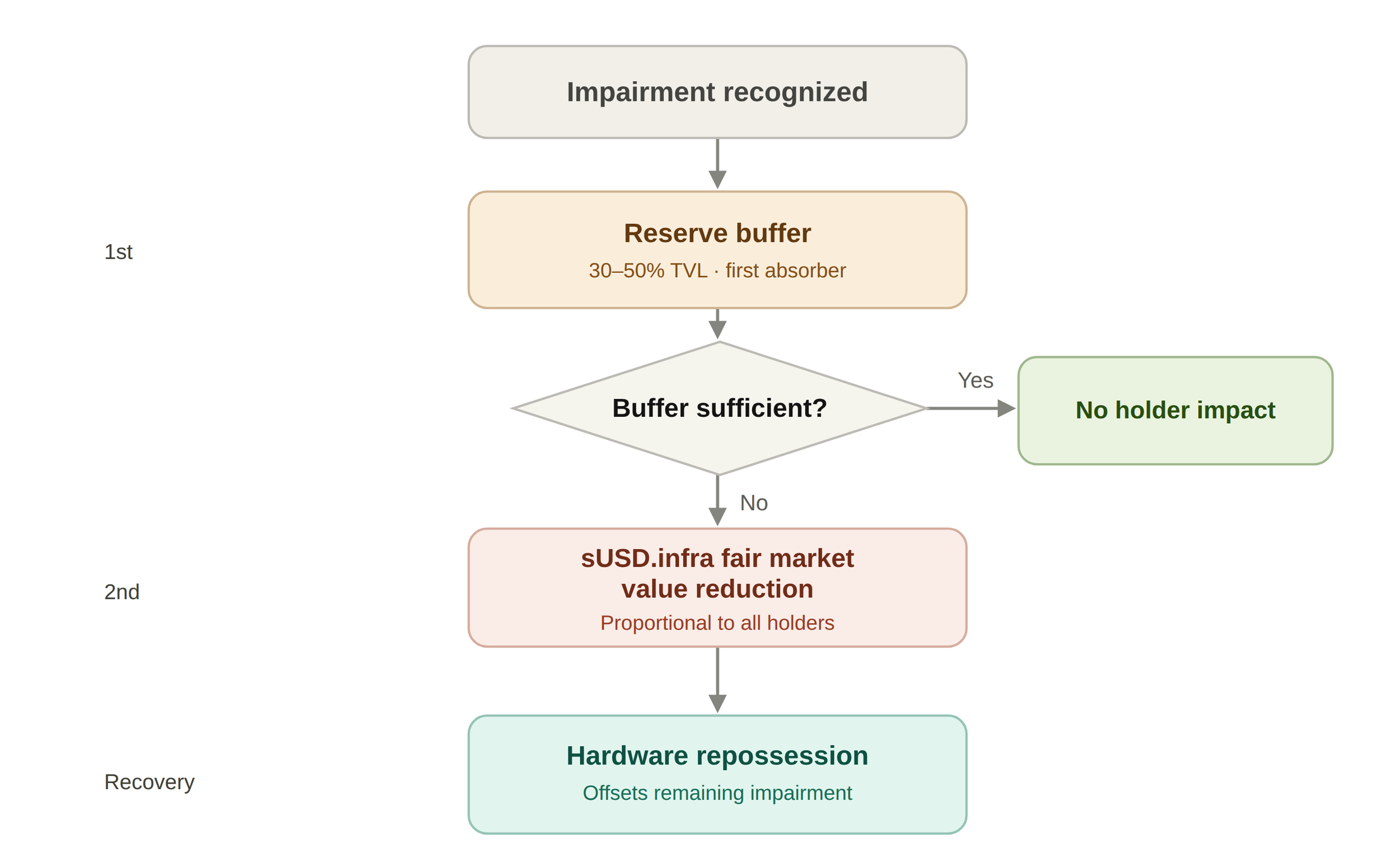
In a default scenario, losses are absorbed in the following order: the reserve buffer is drawn first; if losses exceed the buffer, Vault participants are impacted proportionally through fair market value reduction; physical equipment is then repossessed, with hardware recovery value reducing net impairment.
Governance
Asset allocation decisions are currently made by ranking projects by IRR and capital availability. The protocol intends to formalize a capital committee structure in which a governance token plays a voting role in operator onboarding, deployment approvals, and underwriting standards.
IV. Asset Analysis
4.1 Asset Pool Summary
The USD.infra Vault deploys capital across three categories of real telecommunications infrastructure, each generating recurring, contracted cash flows from real customers paying for essential connectivity services. The asset pool is not speculative. Andrena operates a live ISP business with approximately $4M in existing ARR across all three asset types prior to Vault launch. Each category differs in return profile, payback period, and risk character, but all share the same foundation: contracted revenue from physical infrastructure independent of crypto market conditions. The sections below describe each asset type, its unit economics, and the credit considerations relevant to the Vault.
4.2 Asset Type 1: Apartment Buildings (MDU Wholesale Internet)
4.2.1 Business Model
property, earning a fixed monthly fee per unit regardless of individual tenant take-up or behavior. The revenue counterparty is the building owner, not the resident. This is a commercial B2B relationship, and the building owner absorbs all downstream churn risk. Once the contract is signed, Andrena's revenue stream is fixed and predictable for the life of the agreement.
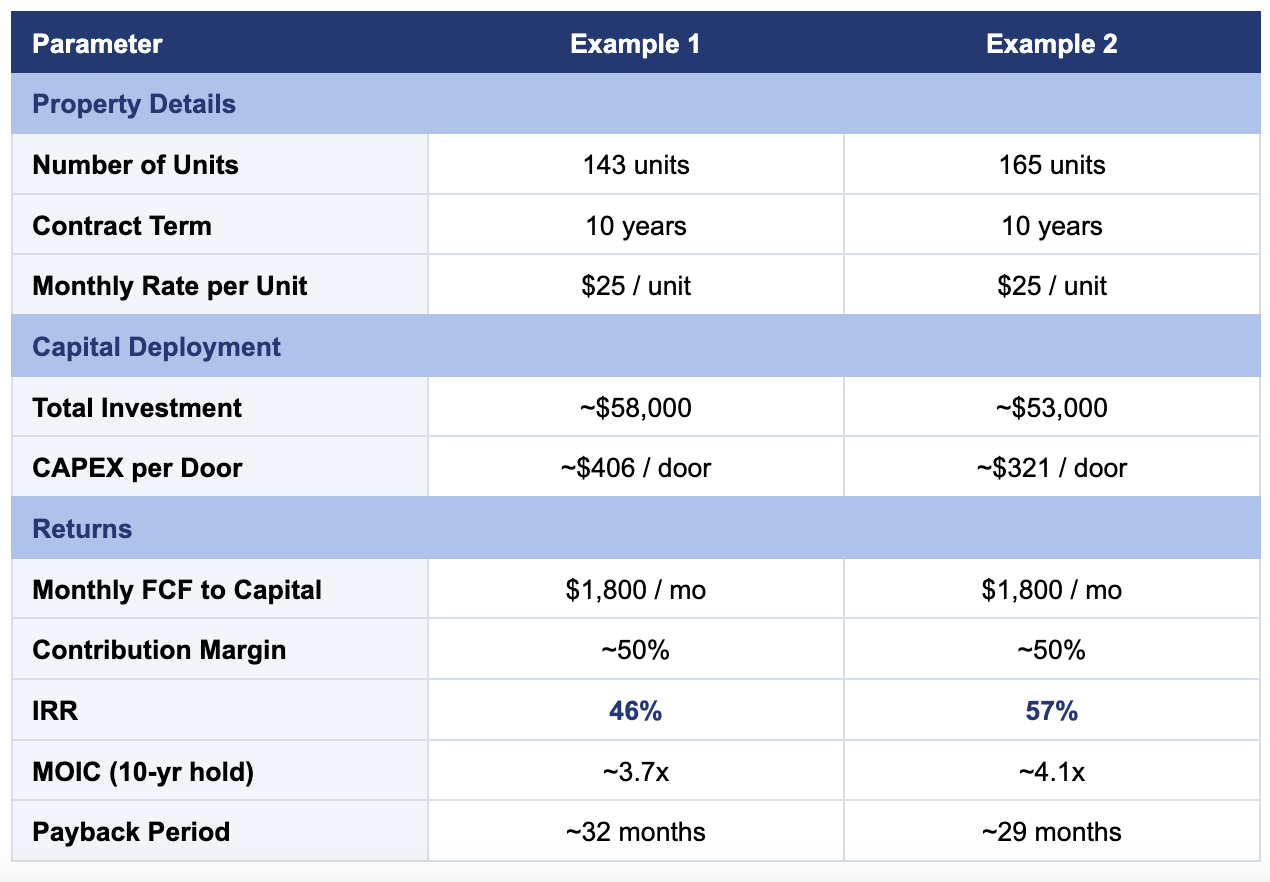
Agreements are structured on 7 to 12 year exclusive terms, providing long-duration revenue visibility that is characteristic of infrastructure rather than consumer-facing telecom. The contracted rate is approximately $25 per unit per month, with most agreements incorporating built-in annual escalators that provide inflation protection over the contract life. Capital deployment per building is approximately $650 per door, producing a contribution margin of approximately 50% and asset-level IRRs in the range of 40 to 57% across Andrena's live examples.
The building owner retains full discretion over how to monetize the service downstream. Some owners pass the cost through to tenants at or near cost as a bundled amenity, improving the property's competitive positioning in the rental market. Others capture a margin by pricing the service above their wholesale cost. In either case, Andrena's economics are unaffected. This structure eliminates the subscriber acquisition, billing, and churn management costs that burden traditional retail ISPs, and replaces them with a single contracted payment obligation from a commercially sophisticated counterparty.
4.2.2 Unit Economics (Illustrative Case Studies)
The two examples below represent live Andrena deployments. All figures sourced from Andrena company materials.
4.2.3 Risk Factors and Mitigants
Building Owner Non-Payment
The primary credit risk in the MDU segment is non-payment by the building owner. Because the revenue counterparty is a commercial entity rather than an individual tenant, standard commercial credit underwriting applies. Prior to contract execution, Andrena conducts public records due diligence on each building owner and any special purpose entity that is party to the agreement, reviewing lien history, occupancy rates, and ownership structure. Buildings with encumbered ownership, distressed occupancy, or unresolved legal claims are excluded from the eligible asset pool. The contracted nature of the revenue stream means that non-performance is a discrete counterparty event rather than a diffuse portfolio risk, and the building itself represents a recoverable hard asset against which a lien can be filed.
Tenant Churn and Occupancy Decline
Because Andrena's revenue obligation runs from the building owner rather than from individual tenants, residential churn does not directly impair cash flow. A tenant vacating a unit does not reduce the monthly payment owed to Andrena. The relevant risk is a sustained and severe decline in building-wide occupancy to a point at which the building owner's own economics become impaired and the contracted payment becomes difficult to service. This scenario is mitigated at underwriting through occupancy rate review and owner credit assessment. It is also the building owner's incentive to maintain the managed WiFi amenity as a competitive differentiator in the rental market.
Contract Non-Renewal at Term End
Agreements run for 7 to 12 years, providing a long base of contracted cash flow visibility before renewal risk becomes relevant. Andrena's asset-level IRR projections incorporate renewal underwriting assumptions, and the capital recovery profile of a typical deployment, with contribution margins near 50% and payback periods well within the initial contract term, means that Andrena recoups its invested capital before the renewal question arises. Non-renewal at term end is therefore a yield impairment risk rather than a loss of principal risk. Andrena's installed infrastructure and existing building relationships also create a meaningful incumbent advantage at renewal.
Technology Obsolescence
Wireless technology standards evolve, and infrastructure deployed today must remain serviceable across a multi-year contract term. Andrena mitigates this risk through two practices. First, each installation is deployed on the WiFi 6 standard, which represents a high performance baseline of wireless technology and provides meaningful headroom over the bandwidth demands expected across a typical contract life. Second, each installation is preceded by an RF survey to ensure optimal hardware placement and signal coverage for the specific building layout, reducing the likelihood of performance degradation that could give a building owner grounds for dispute. Ongoing NOC monitoring allows Andrena to detect and remediate service quality issues proactively, supporting SLA compliance and reducing the risk of contract default triggered by service failure rather than financial stress.
4.3 Asset Type 2: ISP Acquisitions
4.3.1 Business Model
Andrena's ISP acquisition strategy targets sub-scale regional Internet service providers: typically small, privately held operators with established subscriber bases, stable recurring cash flows, and owners who lack a succession plan or the operational scale to compete effectively as the broadband market consolidates. These businesses are available at a structural discount to the broader telecom M&A market precisely because most institutional acquirers will not engage at this deal size. Andrena's ability to operate at this scale, and to integrate acquired businesses into its existing network infrastructure, creates the conditions for a repeatable roll-up strategy with predictable entry multiples and defined synergy pathways.
Acquisitions are targeted at 3 to 5x pre-synergy EBITDA. This entry price reflects the fragmented seller base rather than any underlying credit impairment in the assets. Acquired ISPs carry existing subscriber relationships, contracted recurring revenue, and established network infrastructure. They are cash flow positive at acquisition and require no additional capital to operate. The acquired business generates yield to capital providers from day one, with no contingency on synergy realization.
Value creation occurs through three operational levers applied post-close. The first is network consolidation, where backhaul and data center costs are renegotiated or merged with Andrena's existing infrastructure, reducing COGS materially. The second is field operations overlap, where technician service zones are rationalized across the combined footprint, reducing windshield time and labor cost per service call. The third is NOC and customer support streamlining, where duplicative back-office functions are consolidated onto Andrena's centralized platform. Together, these synergies compress the effective acquisition multiple from approximately 4.1x pre-synergy to approximately 3.2x post-synergy EBITDA on a representative transaction, while generating asset-level IRRs in the range of 25 to 35%. No additional capital is required to realize these improvements; they are operational efficiencies available immediately upon integration into Andrena's existing platform.
4.3.2 Unit Economics (Illustrative Case Study)
The example below reflects a representative city-level ISP acquisition. Synergy categories and return figures are sourced from Andrena company materials; implied EBITDA figures are derived by GridEcon.
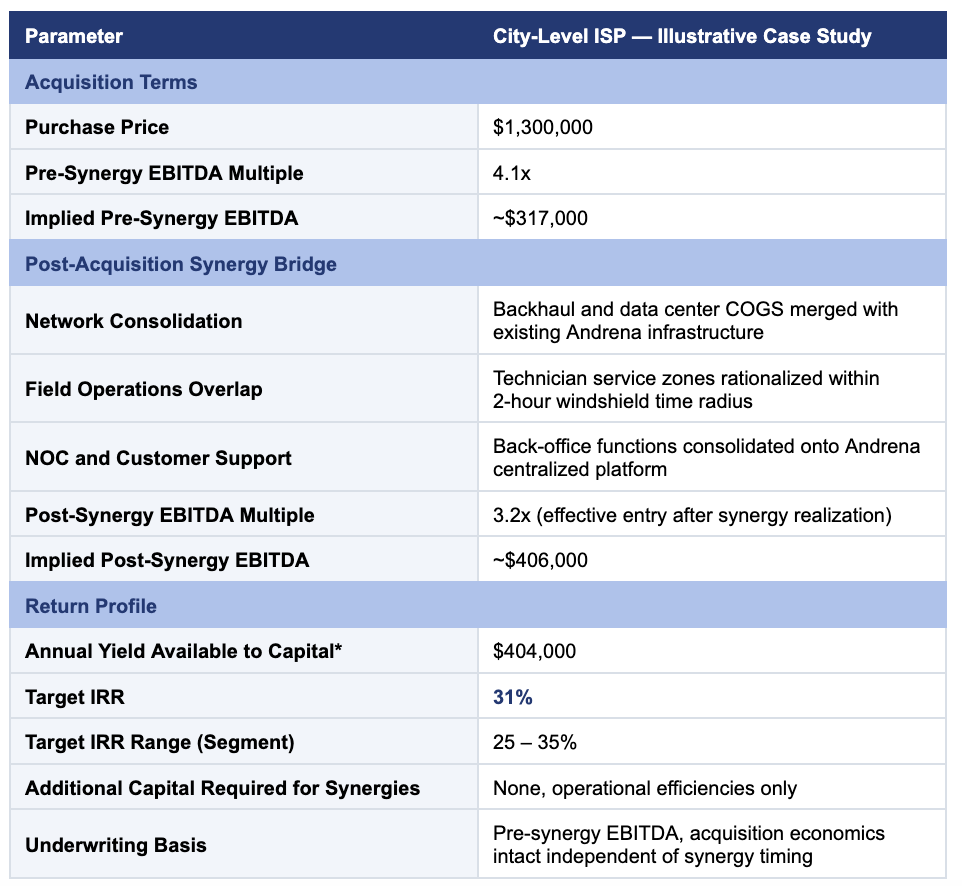
*The $2,000 difference from implied post-synergy EBITDA reflects rounding conventions in source materials not captured in the EBITDA multiple derivation
4.3.3 Risk Factors and Mitigants
Existing Subscriber Retention Risk Post-Acquisition
The primary revenue risk in an ISP acquisition is subscriber attrition following the change of ownership. Residential broadband customers are often loyal to a local provider by habit rather than active choice, and a visible ownership transition can prompt a subset of subscribers to evaluate alternatives. Where deal structure permits, seller earn-out provisions are used to align the prior owner's economic interest with subscriber retention outcomes during the post-close period, providing continuity of service relationships and local operational knowledge. Prior to deal close, Andrena conducts asset-level customer acquisition cost analysis to establish the value of the existing subscriber base and set the retention threshold at which the acquisition economics remain intact. This analysis also informs the purchase price negotiation, ensuring that the entry multiple reflects a realistic rather than theoretical subscriber count.
COGS Optimization Execution Risk
The post-synergy multiple improvement from approximately 4.1x to 3.2x EBITDA depends in part on the ability to reduce cost of goods sold through backhaul renegotiation, data center consolidation, and circuit rationalization. These improvements are not instantaneous. Existing colocation contracts, rooftop lease agreements, and circuit commitments carry their own terms and termination provisions, and the timing of cost reductions is constrained by those contractual obligations. Andrena mitigates this risk by conducting a detailed review of all existing vendor contracts prior to close, mapping the timing of available renegotiation windows and early termination costs against the projected synergy schedule. Critically, the acquisition is underwritten and priced against pre-synergy EBITDA, meaning that the contracted cash flows at close are sufficient to service the acquisition cost independent of whether synergies are realized on schedule. Synergy delivery accelerates returns; it is not a precondition for positive FCF.
Integration Complexity and Field Operations Overlap
Integrating field operations across a combined service territory introduces execution risk, particularly where technician dispatch, equipment inventory, and service scheduling must be consolidated across two previously independent organizations. Andrena's geographic concentration strategy mitigates this risk structurally. Acquisition targets are selected in part on the basis of service territory proximity to existing Andrena operations, with a two-hour technician windshield time used as the practical threshold for service zone overlap. Within that radius, field teams from the acquired and existing operations can share dispatch, reducing redundant headcount and vehicle costs without requiring new hires or significant retraining. NOC consolidation follows a defined playbook rather than being rebuilt from scratch at each acquisition, reducing the time and operational disruption associated with bringing a new network under centralized monitoring. Together, these constraints bound the integration complexity to a manageable scope and allow synergies to be realized on a timeline consistent with the acquisition underwriting.
4.4 Asset Type 3: Commercial Real Estate Carrier Offload
4.4.1 Business Model
Andrena's carrier offload segment deploys WiFi infrastructure across commercial real estate venues, including quick service restaurants, cafes, gas stations, and retail locations, and monetizes that infrastructure by selling cellular data offload capacity to national carriers such as T-Mobile on a per-gigabyte basis. The revenue model is usage-based rather than contracted at a fixed monthly rate, with Andrena earning negotiated rates per gigabyte of carrier traffic routed through its deployed access points. This positions the segment as a direct beneficiary of mobile data consumption growth, with no capital required beyond the initial hardware installation.
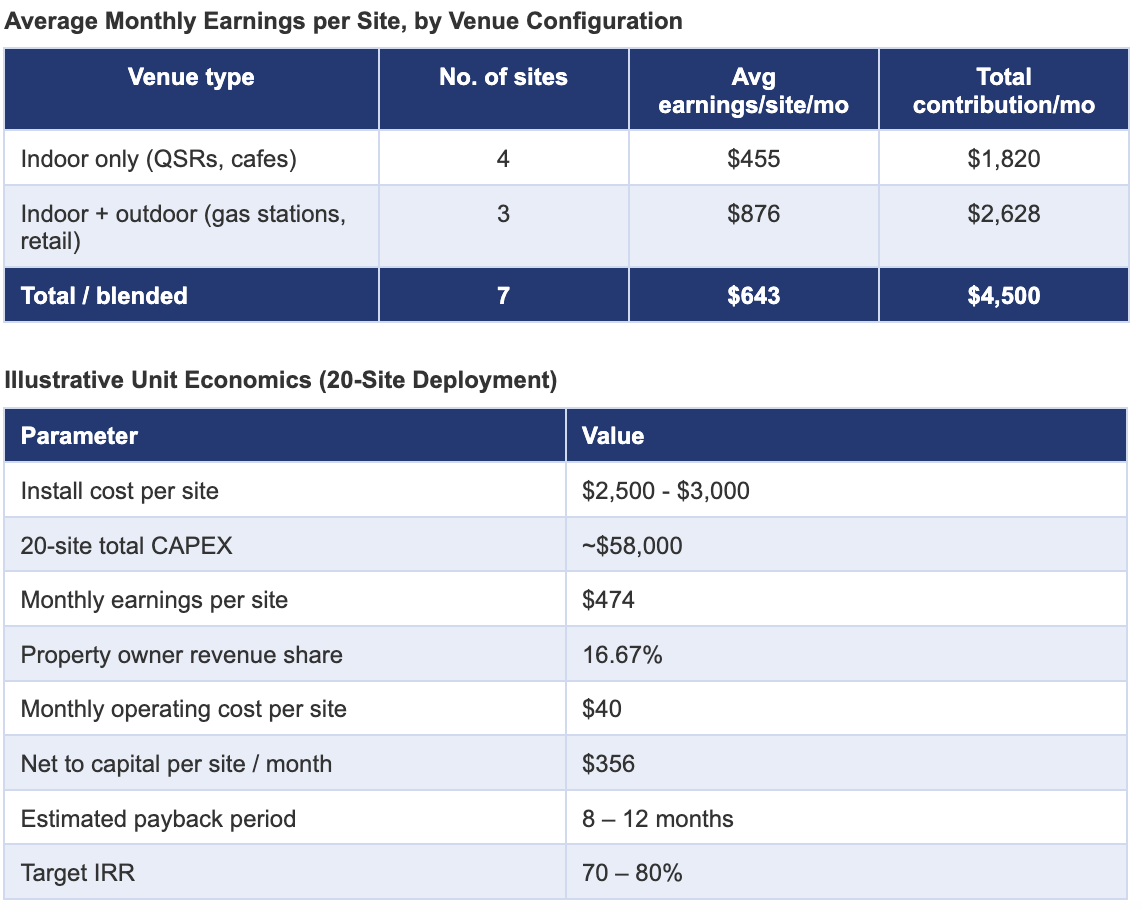
The economic structure of the segment is straightforward. Revenue in the carrier offload segment is usage-based, scaling with per-gigabyte data throughput routed through Andrena's deployed access points. Net cash flow is realized after the property owner’s revenue share and other operating costs are deducted from gross site earnings. Capital intensity per site is low relative to Andrena's other two asset types. In site identification, Andrena targets an estimated payback period of 8 to 12 months on new deployments, the fastest capital recovery profile of the three asset types. This produces asset-level IRRs in the range of 70 to 80%, the highest in the portfolio.
Deployments are executed on both a brownfield and greenfield basis across large commercial footprints. Venue type materially affects revenue. Andrena's live cohort data across seven sites demonstrates that indoor-plus-outdoor deployments, such as gas stations and retail locations with exterior traffic, generate approximately 1.9 times more revenue per month than indoor-only venues such as cafes and quick service restaurants, reflecting the higher data throughput associated with outdoor dwell patterns and vehicular traffic. Indoor-only sites in the live cohort average approximately $455 per month, while indoor-plus-outdoor sites average approximately $876 per month.
4.4.2 Unit Economics (Illustrative Case Study — Live Cohort)
4.4.3 Risk Factors and Mitigants
Carrier Dependency
The carrier offload revenue model is currently dependent on commercial relationships counterparties. Concentration in any given carrier introduces the risk that a change in offload pricing, program structure, or carrier strategy could impair revenue across the deployed site portfolio. Andrena mitigates this risk at the underwriting stage by analyzing each site's economics against different carriers independently, such that a deployment must meet return thresholds before capital is committed. This ensures that no site's viability is contingent on one carrier maintaining its current program. The underlying demand driver, mobile data consumption growth, is structural and carrier-agnostic. Foot traffic analysis conducted prior to each deployment establishes a site-level throughput baseline that is independent of which carrier's traffic is being offloaded, providing a demand foundation that is not sensitive to carrier-specific program changes.
Data Demand Variability at the Site Level
Individual site revenue is a function of data throughput, which varies with foot traffic patterns, venue type, and seasonal demand. A single site experiencing lower-than-projected throughput represents a meaningful revenue shortfall relative to its projected contribution. Andrena manages this risk primarily through portfolio construction rather than site-level hedging. Deployments are diversified across venue types, with indoor-only locations such as cafes and quick service restaurants blended with higher-throughput indoor-plus-outdoor venues such as gas stations and retail locations. The live cohort data demonstrates that indoor-plus-outdoor sites generate approximately 1.9 times the monthly revenue of indoor-only sites, providing a natural offset within a mixed portfolio. Critically, the capital at risk per site is limited. At approximately $2,500 - $3,000 per installation and an 8 to 12 month payback period, Andrena recovers its invested capital within the first year of operation. This short exposure window materially bounds the downside of any single site underperforming, as the capital base is largely recovered before a sustained revenue shortfall could constitute a principal loss.
Bandwidth and SLA Compliance
Carrier offload agreements carry implicit or explicit service quality obligations. Failure to maintain adequate throughput, uptime, or quality of experience at the site level could result in reduced per-gigabyte compensation or disqualification from carrier offload programs. Andrena addresses this risk through three practices applied at both the installation and operational stages. Each site is deployed at least a WiFi 6 standard, providing meaningful headroom over current bandwidth demands and reducing the likelihood of congestion-driven SLA failures. Each installation is preceded by an RF survey to optimize hardware placement for the specific physical environment, minimizing coverage gaps and signal degradation before the site goes live. Ongoing NOC monitoring enables proactive identification and remediation of performance issues across the deployed portfolio. Network performance is additionally published on-chain through Andrena's Proof of Bandwidth mechanism, providing verifiable, real-time visibility into site-level service quality for both carriers and Vault participants.
4.5 Acquisition Pipeline
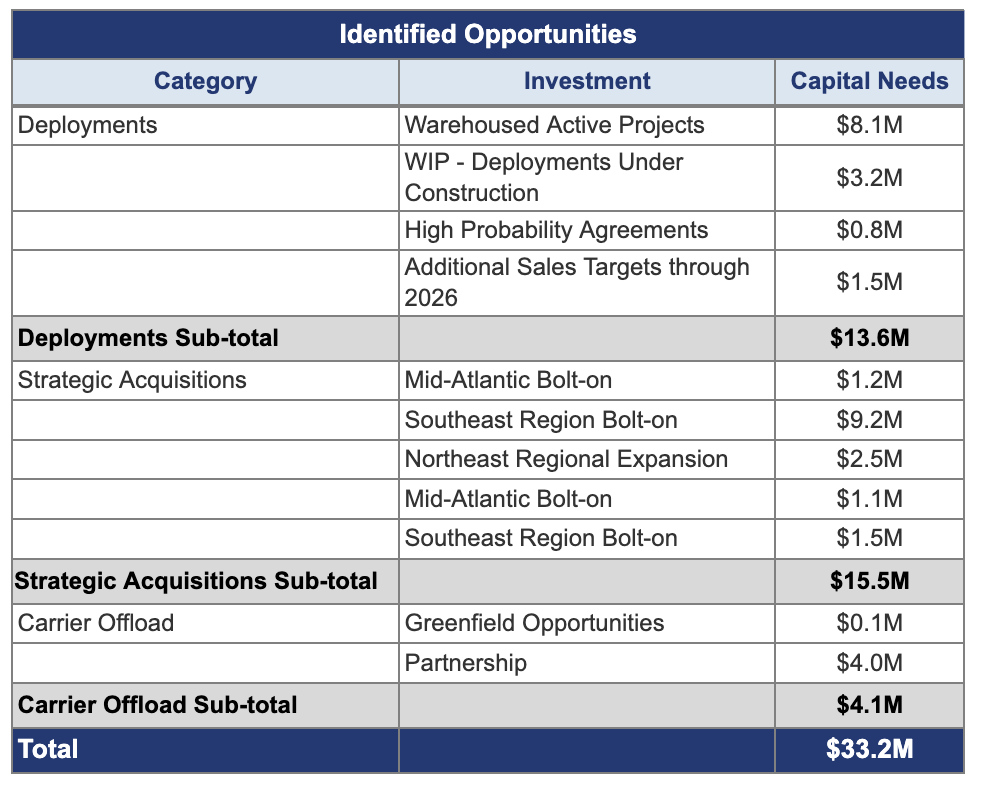
Andrena maintains an active capital deployment pipeline across all three asset categories, with opportunities at varying stages of maturity from warehoused active projects through to early-stage acquisition discussions. The pipeline reflects Andrena's ability to source and advance opportunities across its MDU, ISP acquisition, and carrier offload segments concurrently, with the majority of identified capital needs supported by signed letters of intent or active purchase agreement negotiations.
V. Token and Capital Structure
5.1 Token Overview
DAWN issues two tokens that together form the entry and yield layer of the USD.infra Vault. USD.infra is a dollar-pegged stablecoin minted 1:1 against USDC and backed by U.S. Treasuries through M0 Protocol, serving as the unit of account for all Vault deposits. sUSD.infra is the yield-bearing Vault token received upon deposit, non-rebasing, composable across DeFi, and designed to appreciate in exchange rate as interest paid via telecom revenue accrues to the Vault. The two tokens are functionally distinct: USD.infra is the stable entry point, while sUSD.infra represents the holder's pro-rata claim on deployed infrastructure yield.

5.2 Capital Flow Architecture
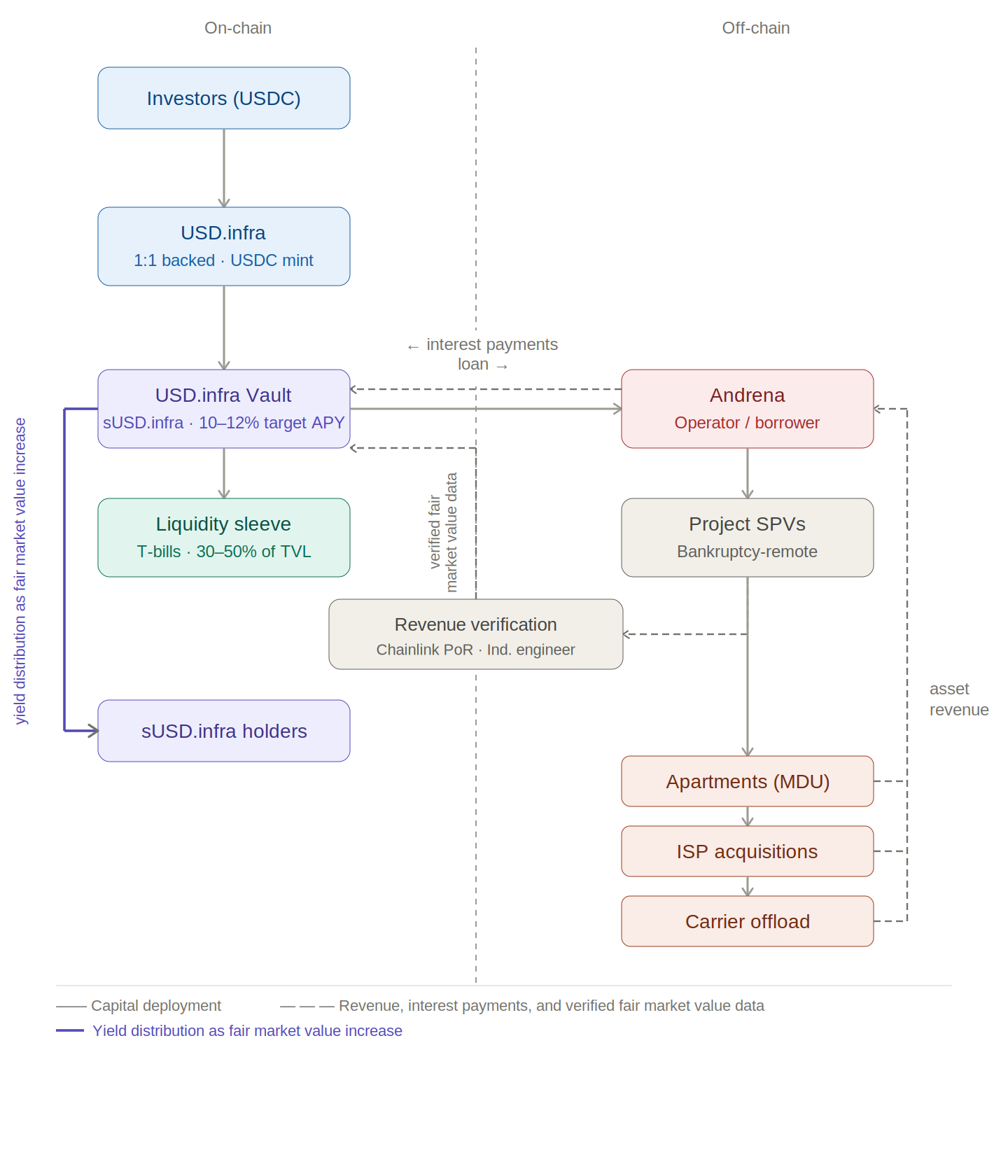
The USD.infra Vault channels stablecoin deposits into U.S. wireless telecom infrastructure and realizes yield as sUSD.infra fair market value appreciation.
Depositors convert USDC to USD.infra on a one-to-one basis and receive sUSD.infra, the yield-bearing Vault token, in return. The Vault issues loans to Andrena, which deploys capital across wholesale MDU agreements, carrier offload installations, and telecom acquisitions. Each loan is collateralized by the underlying assets held in a bankruptcy-remote SPV, ring-fencing investor exposure from Andrena's corporate balance sheet. Revenue generated by the underlying telecom assets is verified on-chain via Chainlink Data Streams and a third-party reviewer before interest accrues to the Vault. A structural liquidity buffer of 30 to 50% of TVL is maintained in wM, a T-bill-backed instrument from M0 Protocol, to support redemptions without requiring liquidation of deployed assets. The Vault targets 10 - 12% APY. See the following graphic for a visual representation of the capital flows.
The loan rate charged to Andrena on deployed capital is not fixed at a single contractual rate but is instead governed by DAWN’s underwriting standards. The Vault functions as a committed credit facility, and Andrena draws from it at a rate in the range of 15 to 20% dependent on asset credit worthiness.
5.3 Capital Stack

The USD.infra Vault functions as an on-chain private credit facility, issuing loans against a portfolio of contracted telecom infrastructure assets. Capital enters the Vault as USDC, is minted into USD.infra on a 1:1 basis, and is deployed via the Vault's lending facility. Andrena deploys that capital into bankruptcy-remote project SPVs. Revenue generated by those assets flows back to Andrena, which services its loan obligations to the Vault. An independent verification layer, combining Chainlink Proof of Reserves and third-party reviewer confirmation, attests to asset performance and feeds verified fair market value data back to the Vault on-chain. A liquidity sleeve, held in T-bills at 30–50% of total value locked, ensures a portion of capital remains redeemable at fair market value at all times. Net yield is distributed to sUSD.infra holders as an increase in token fair market value. Please see the following chart for visualization of the deal structure and capital flows.
Loss Waterfall
In a default scenario, losses are absorbed sequentially across three layers before Vault participants are impaired. The reserve buffer is drawn first, providing a first line of protection funded by the liquidity sleeve maintained at 30 to 50% of TVL. If losses exceed the reserve buffer, sUSD.infra holder fair market value is reduced proportionally across all Vault participants. Physical equipment is repossessed in the final stage, with hardware recovery value reducing net impairment to the Vault. The structure is designed so that the reserve buffer absorbs all but the most severe loss scenarios before any reduction in sUSD.infra fair market value is required.
5.4 Fair Market Value Methodology and Oracle Architecture
DAWN’s Vault fair market asset value is calculated from four discrete components, each sourced and updated independently. The formula is as follows:
Vault Fair Market Value = Undeployed Reserves + Deployed Capital + Accrued Interest* - Impairments
*investor redemption completed before interest is paid to fair market value forgo accrued interest
Each component updates at a different cadence and is sourced from a different system. The following table below describes the data architecture for each input.
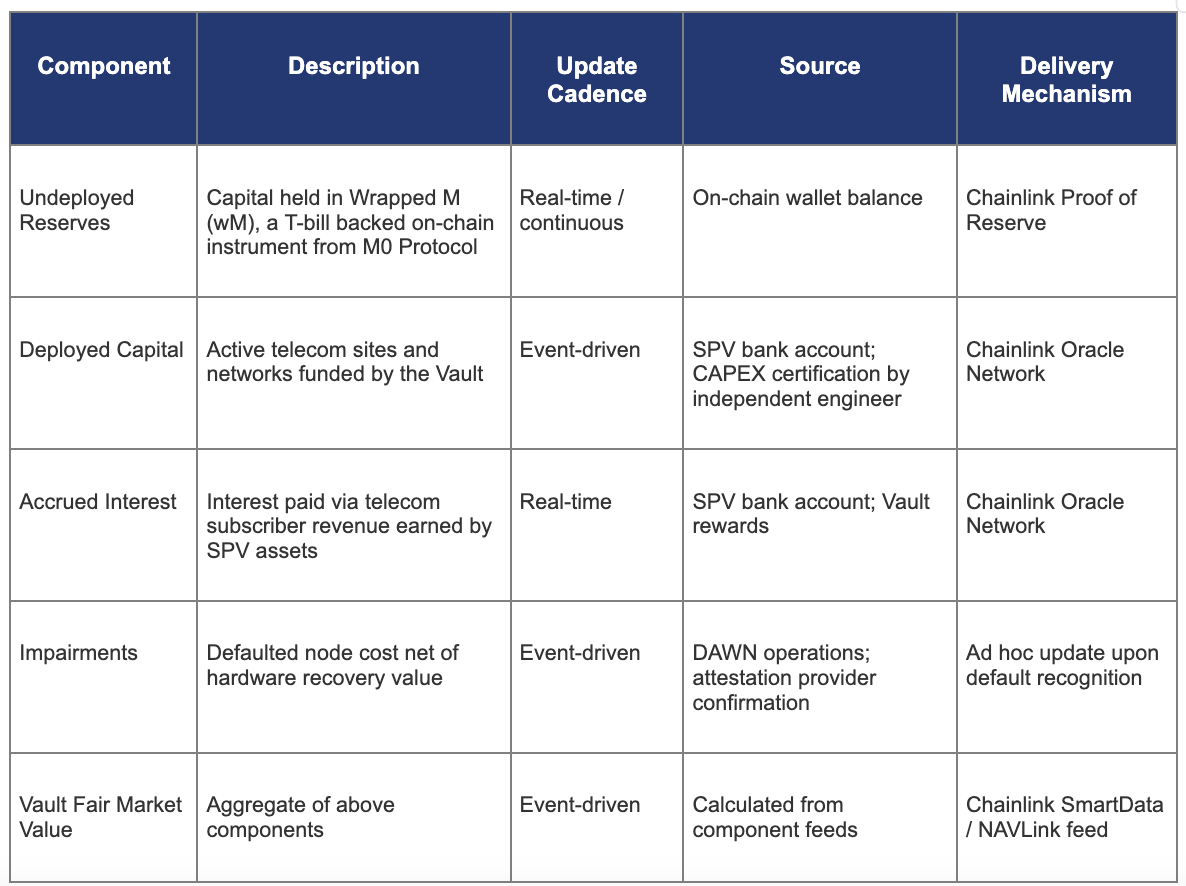
The aggregate fair market value is recalculated from these inputs and published on-chain via Chainlink's NAVLink feed. This provides token holders with a continuously accessible, oracle-sourced representation of Vault value without requiring a request to the operator.
USD.infra Proof of Reserve
Separate from the Vault fair market value, USD.infra requires a dedicated Proof of Reserve feed confirming 1:1 backing by wM. This is a standard Chainlink PoR integration. It reads the wM wallet balance directly and ensures that USD.infra is fully collateralized at all times. This feed is a prerequisite for DeFi protocol integrations and is the mechanism by which the stablecoin peg is verifiable on-chain without reliance on operator disclosure.
Independent Engineer Function
Two of the four fair market value components, deployed capital and impairments, have off-chain sources and cannot be verified by on-chain wallet reads alone. An independent engineer is engaged to perform the physical and operational validation required to support these inputs. Specifically, the attestation scope covers four areas: (1) confirmation that nodes are physically deployed and operational; (2) confirmation that defaulted nodes are non-operational and impairments are therefore justified; (3) validation of hardware recovery values in repossession scenarios; and (4) confirmation that underlying revenue contracts with building owners and network operators exist and match the terms reported by DAWN.
The independent engineer's certification triggers the Chainlink oracle update for the deployed capital component. This creates a documented link between physical site status and on-chain fair market value.
SPV Isolation and Legal Structure
Each telecom deployment is held in a bankruptcy-remote special purpose vehicle. Interest paid via revenue from subscriber fees flows from the asset into the SPV bank account, and from there into the Vault's accrued interest calculation. This structure isolates individual deployment risk from DAWN and Andrena's corporate balance sheets. Per founder representations, the Vault's security interest runs against cash flows, underlying revenue contracts, and physical hardware. A formal lien and contract assignment structure is intended, though documentation confirming that UCC filings or equivalent have been completed is outstanding and should be confirmed prior to final credit approval.
Launch Disclosure and Attestation Timeline
At launch, DAWN may self-report the deployed capital and impairment components. Chainlink's oracle infrastructure supports self-reported feeds with appropriate disclosure. Independent third-party attestation is targeted within two to three months of launch. This represents a material gap in the verification architecture during the initial deployment period. Investors should treat self-reported fair market value components as unaudited values until independent attestation is in place. This is a standard limitation in early-stage RWA structures and should be reflected in any yield premium analysis for the launch period.
VI. Liquidity and Exit Mechanics
6.1 Primary Redemption Mechanism
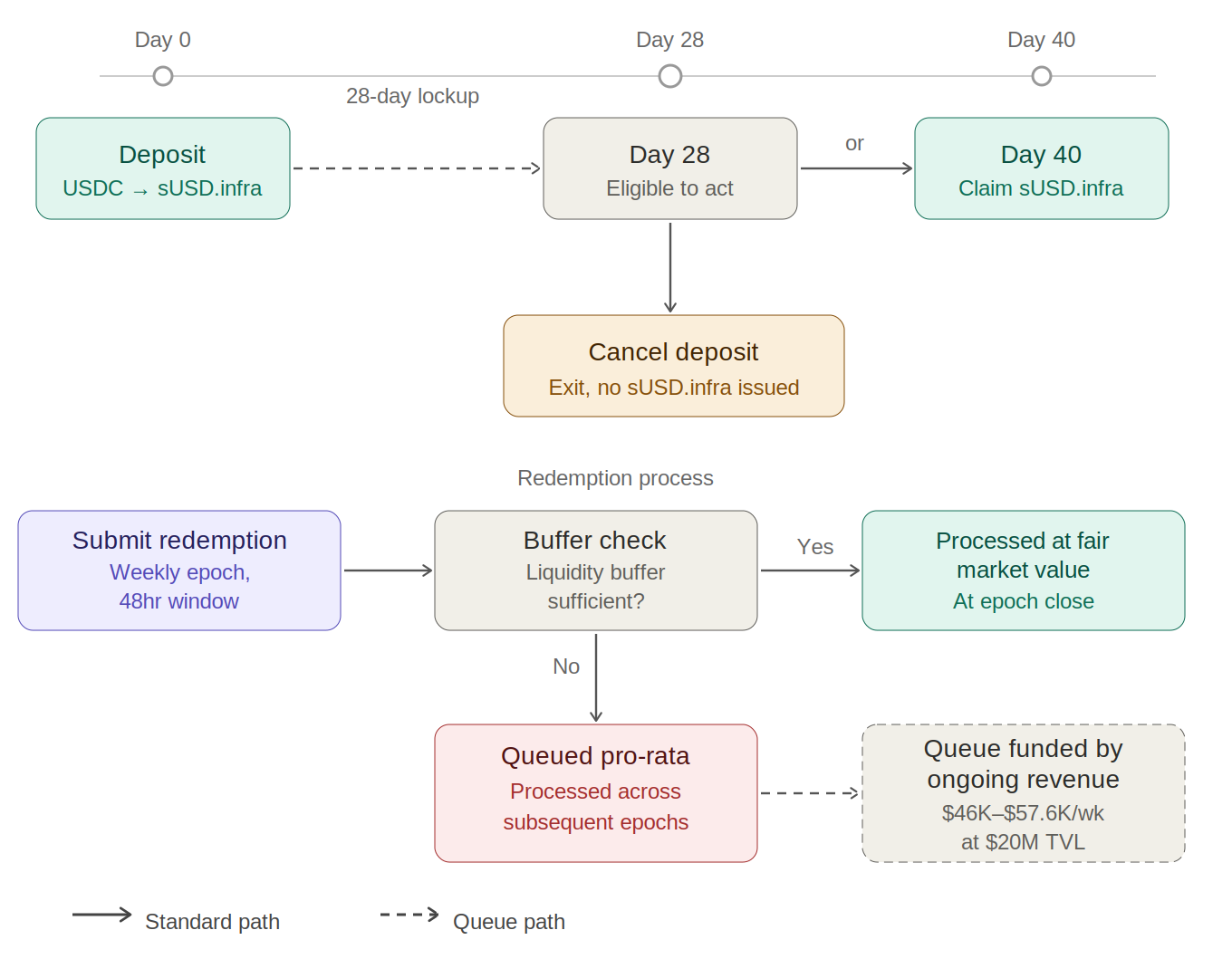
Investors deposit USDC into the Vault and receive sUSD.infra in return. Deposits are subject to a 28-day lockup period, at which point the investor may either cancel and exit without receiving sUSD.infra, or proceed to Day 40 to claim their position. Once holding sUSD.infra, redemptions are submitted during a weekly epoch with a 48-hour submission window. If the Vault's liquidity buffer is sufficient, the redemption is processed at fair market value at epoch close. If the buffer is insufficient, the request is queued and processed pro-rata across subsequent epochs, funded by ongoing interest payments of approximately $46k to $57.6k per week at $20 million TVL. Redemptions completed before accrued interest is disbursed to fair market value, forgo the accrued interest.
6.2 Liquidity Buffer Design
The Vault maintains a liquidity reserve ranging from 30 to 50% of TVL at any given time. This capital is held in wM, a T-bill-backed on-chain instrument issued through M0 Protocol, and earns a base rate of approximately 4% annually. The reserve is not idle from a return perspective, but its primary function is structural: it absorbs redemptions without requiring liquidation of deployed telecom assets.
The Season 1 buffer posture reflects a considered allocation of risk. The underlying telecom assets carry low cash flow volatility. Long-duration contracted receivables from MDU broadband agreements, carrier offload deployments, and acquired ISP operations do not exhibit the mark-to-market sensitivity that characterizes most on-chain yield products. The primary uncertainty at this stage of the protocol is not asset performance but depositor behavior in an unfamiliar product category. The decision to hold 30 - 50% in reserve directly addresses that uncertainty.
Buffer Sizing and Redemption Capacity
The Vault's epoch system processes redemptions on a weekly cycle, with a 48-hour submission window. This incremental inflow supplements the standing reserve as a secondary source of redemption funding.
The following table illustrates coverage across five exit scenarios at $20M TVL and a 45% buffer. Each row represents a hypothetical scenario in which a given percentage of all depositors submit redemption requests simultaneously. Scenarios up to 45% of TVL are covered in full through instant redemption at fair market value. Scenarios beyond that threshold require partial queuing and secondary market participation.
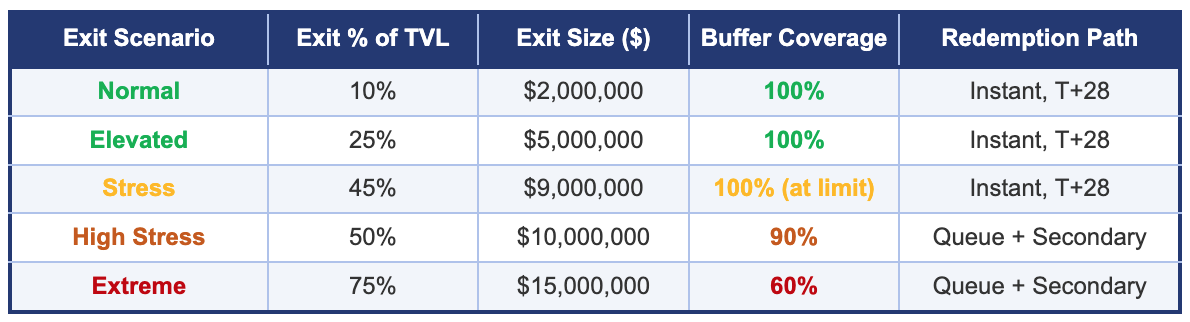
Note: Each scenario represents simultaneous redemption requests from the stated percentage of all depositors. Buffer covers requests at or below 45% of TVL at fair market value. Requests above that threshold enter the epoch queue or exit via secondary market. Parameters adjust as TVL scales.
For Season 1, DAWN has made a deliberate decision to prioritize exit stability over yield maximization. The underlying telecom assets generate predictable, contracted cash flows with low default risk. Given that the asset base is conservative by nature, management has determined that the more meaningful risk to address in the protocol's early stage is redemption confidence, not yield compression. The liquidity sleeve buffer reflects that priority directly. It is set toward the upper end of the 30 to 50% operating range, accepting a modestly lower blended yield at launch in exchange for a redemption profile that covers all realistic exit scenarios at fair market value without queue involvement.
6.3 Secondary Market Exit
Following the 40-day holding period required under Regulation S, sUSD.infra is freely tradable on secondary markets. Expected venues include Raydium and Orca liquidity pools on Solana, OTC markets, and potential centralized exchange listings subject to venue availability. Secondary market execution is immediate and requires no epoch submission or queue, with price determined by market participants rather than fair market value. A holder who sells sUSD.infra on the secondary market transfers the entire yield position to the buyer, who assumes all future yield rights and redemption eligibility from the point of purchase.
Secondary market pricing relative to fair market value is a function of yield competitiveness and redemption pressure. sUSD.infra is expected to trade at a premium to fair market value when the Vault's yield spread over on-chain alternatives is wide, redemption demand is low, and there is strong market appetite for real-world yield exposure. It is expected to trade at a discount when Vault yield compresses relative to competing products, when redemption pressure is elevated and the primary buffer is visibly strained, or when broader on-chain liquidity stress reduces risk appetite across the DeFi ecosystem.
The relationship between secondary market depth and primary redemption pressure is self-reinforcing. When sUSD.infra trades at a premium and secondary liquidity is deep, holders seeking exit can sell into the market rather than submitting primary redemption requests. This reduces demand on the liquidity buffer, preserving it for holders who require fair market value-based redemption. Conversely, a shallow or discounted secondary market concentrates exit pressure on the primary mechanism. The Vault's Bytes incentive program is designed in part to address this dynamic directly, with concentrated DEX liquidity provision earning a 4.5x activity multiplier, making secondary market depth a rewarded protocol behavior rather than a passive outcome.
VII. Yield Analysis
7.1 Yield Dynamics with the Self Correcting Mechanism
Effective yield is a function of utilization. The Vault expresses this relationship as: Effective APY = Target APY × Utilization Rate (Where utilization is defined as deployed capital divided by total deposits.)
When TVL grows faster than Andrena's capacity to deploy capital into new telecom assets, utilization falls and blended yield compresses toward the T-bill floor. This reduces the Vault's attractiveness relative to competing yield products. Deposits slow and some holders exit, which raises utilization as the denominator shrinks. As Andrena deploys incremental capital into contracted infrastructure, utilization recovers and yields returns toward and above the 10 - 12% range. This mechanism is structurally anchored in operational performance rather than market sentiment. Yield improvement requires actual deployment of physical assets under revenue-generating contracts. It cannot be manufactured through token incentives or protocol subsidies.
A secondary source of yield lift comes from the reinvestment of repaid principal and interest. As Andrena repays loan principal during a given epoch, those proceeds are redeployed into new RWA loans at the 15 - 20% rate rather than held in the treasury reserve at 4%. The spread between those two rates is the value created per dollar recycled. This mechanism can contribute up to approximately 0.31% of additional annual yield depending on utilization and loan rates.
7.2 Competitive Yield Positioning
The USD.infra Vault targets a yield that sits materially above the risk-free rate and conventional fixed income alternatives, while offering a significantly shorter lockup period than comparable private credit or corporate bond structures. The table below benchmarks sUSD.infra against a range of yield-bearing instruments across both traditional and on-chain capital markets. At 10 - 12% APY with a 28-day redemption window, sUSD.infra occupies a distinct position in the yield landscape: offering private credit-level returns with liquidity terms closer to DeFi money markets. The yield premium over investment grade corporate bonds and prime lending rates reflects the illiquidity of the underlying telecom assets and the early-stage nature of the protocol, rather than elevated credit risk. The Vault's underlying cash flows are contracted, asset-backed, and generated by essential connectivity infrastructure. See the following table for yield comparison across asset classes.
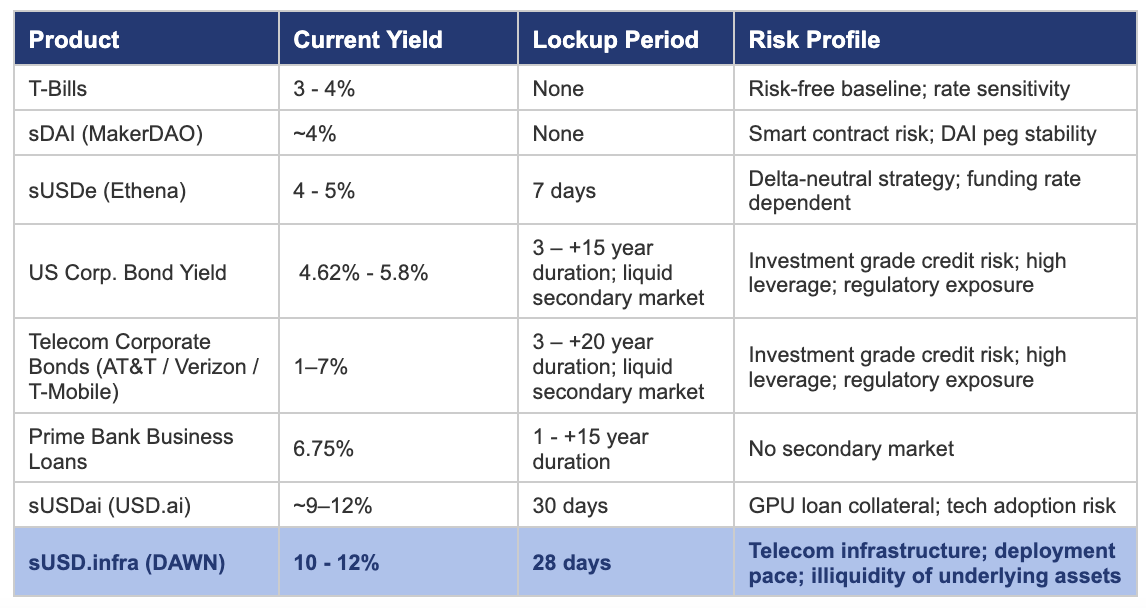
Sources: T-Bills, sDAI, sUSDe, US Corp Bond Yield, Tmobile, Verizon, AT&T*, Prime Bank Business Loans, USDai
*AT&T corporate rates can exceed 7% due to effective yields on bonds of acquired companies that were originated pre acquisition
7.3 Yield Sensitivity Analysis
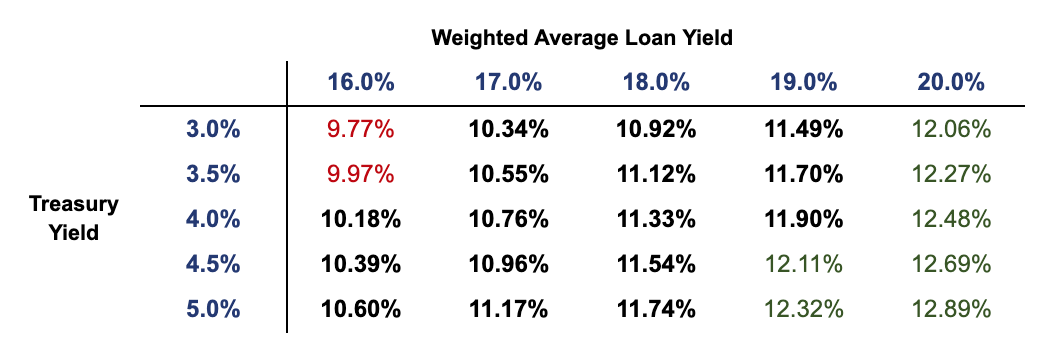
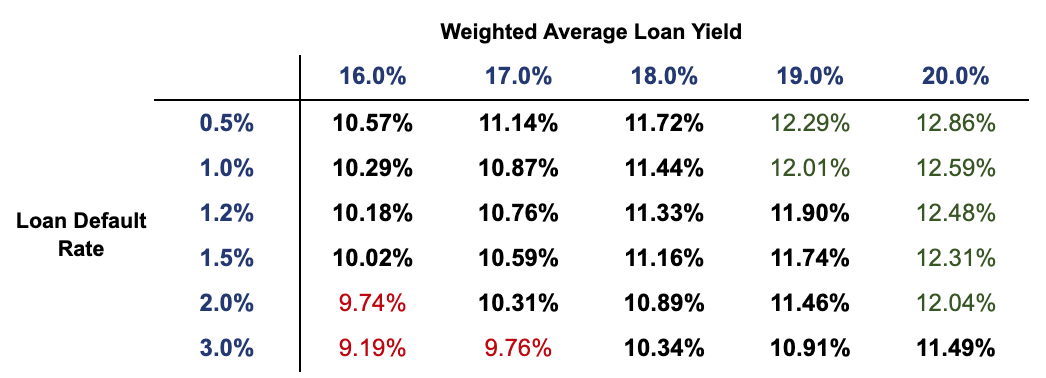
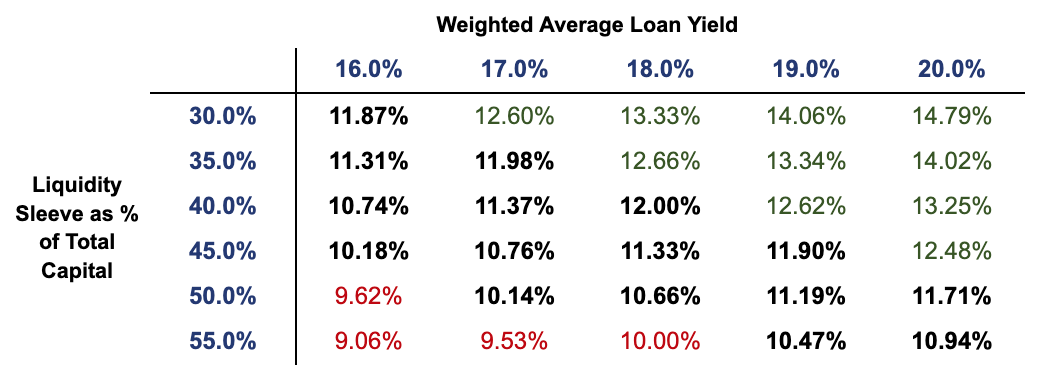
The DAWN USD.infra Vault yield is a function of three primary variables: the deployed capital yield on the underlying loan book, weighted average treasury yield earned on the liquidity sleeve, and the annual default rate applied against the deployed balance. The sensitivity tables below model net Vault yield across realistic ranges of each variable, holding the deployed sleeve at 55% and the liquidity sleeve at 45% unless otherwise specified.
VIII. Points Program and Incentive Structure
8.1 Bytes Program (Season 1)
Bytes is the reward unit through which DAWN distributes future $DAWN token ownership to early protocol participants. Any holder or user of USD.infra or sUSD.infra earns Bytes hourly according to the formula: Bytes Earned = Balance × Activity Multiplier × Epoch Multiplier. The Activity Multiplier ranges from 1x for passive holding to 4.5x or higher for concentrated DEX liquidity positions. The Epoch Multiplier begins at 3.0x in the Genesis epoch and decays to a baseline of 1.0x by approximately week nine, front-loading rewards toward earliest participants.
The activity tier structure is designed to build secondary market depth during Season 1. Passive sUSD.infra holding earns a 1x multiplier. Supplying to approved lending venues earns 2x. Yield trading venues earn 3x. Concentrated DEX liquidity earns 4.5x or higher. Projected Bytes APYs of 10% to 47% across these tiers are illustrative, based on an assumed $DAWN token price at conversion, and are not guaranteed returns.
Vault yield and Bytes rewards are separate and additive streams. The 10 - 12% yield described in Section 7 is generated entirely from contracted telecom cash flows and is independent of Bytes activity.
From a credit perspective, the program addresses two structural priorities for Season 1. First, it broadens the depositor base beyond holders anchored purely in the telecom yield, supporting TVL stability during the period when the Vault's operating track record is being established. Second, by paying its highest multipliers to participants providing DEX liquidity and engaging lending markets, the program directly incentivizes the secondary market depth that reduces primary redemption pressure on the liquidity buffer. If the program functions as intended, the Vault should enter Season 2 with an established secondary market that reduces reliance on the epoch queue as the primary exit path.
IX. Risk Analysis
9.1 Operator Risk
In Season 1, the USD.infra Vault depends on Andrena as its sole operating counterparty across all three asset types. Andrena sources deals, deploys capital, manages network infrastructure, services existing subscribers, and executes ISP acquisitions. Concentration of these functions in a single operator represents a material operational risk that investors should evaluate alongside the structural protections built into the capital architecture.
Andrena's current deployment infrastructure has been validated at its existing subscriber scale, with over 15k subscribers across 10 U.S. states, but the capacity to simultaneously manage a growing MDU portfolio, execute multiple ISP acquisitions, and expand carrier offload deployments across new commercial venues has not yet been demonstrated at the scale implied by the broader strategy. These three workstreams require distinct operational capabilities. MDU growth requires active building owner sales and installation logistics. ISP acquisitions require deal sourcing, legal execution, and post-close integration. Carrier offload requires site-by-site venue contracting and hardware management. Each is operationally independent, and all three are expected to run concurrently.
Two structural mitigants bound the consequences of the potential of an Andrena operational underperformance for Vault participants. The SPV structure isolates each deployed asset's cash flows from Andrena's corporate balance sheet. Assets held in bankruptcy-remote SPVs continue to generate revenue independently of Andrena's operating condition, with recovery available through the collateral enforcement mechanisms described in Section 5. The DAWN protocol governance layer, including a capital committee with governance token participation, provides an institutional oversight mechanism that operates separately from Andrena's management, limiting the degree to which Andrena can unilaterally direct Vault capital without protocol-level approval.
9.2 On-Chain / Smart Contract Risk
The USD.infra Vault is deployed on Solana and relies on a stack of on-chain infrastructure across three layers: the Solana blockchain itself, the smart contracts governing USD.infra and sUSD.infra, and the Chainlink oracle network responsible for publishing Vault fair market value on-chain. Each layer carries distinct risk characteristics that are independent of the underlying telecom asset performance.
Solana Platform Risk
Solana has experienced network outages and performance degradation events in its operating history, and investors should treat platform availability as a background risk rather than a theoretical one. A Solana outage would not impair the underlying telecom assets or the SPV cash flows, but it would temporarily prevent redemption submissions, fair market value updates, and secondary market trading. The practical consequence is a delay in exit execution rather than a loss of principal.
Smart Contract Risk
The Vault relies on two smart contract systems with distinct audit status. USD.infra is built on M0's wM infrastructure. The M0 smart contract audit is understood to be substantially complete. sUSD.infra is built by Concrete, formerly Glow. At launch, both parties carry liability for smart contract risk on their respective contracts. A vulnerability in either contract could expose depositor funds to loss independent of underlying asset performance.
Oracle Failure Modes
The Vault fair market value is composed of four components, undeployed reserves, deployed capital, accrued interest, and impairments. Each of these updates at a different cadence and are published on-chain via Chainlink's SmartData and NAVLink feed. Undeployed reserves are updated continuously via Chainlink Proof of Reserve. Deployed capital and accrued interest are updated on an event-driven basis from off-chain SPV bank accounts, with independent engineer certification for capital deployments and Chainlink oracle delivery for interest accrual. Impairments are updated on an ad-hoc basis when a default is recognized.
A Chainlink oracle failure would delay fair market value updates but would not impair the underlying assets or their cash flows. The practical consequence is that the published on-chain fair market value would become stale, which could affect redemption pricing and secondary market confidence until the feed is restored. Deployed capital certification and impairment recognition both depend on off-chain inputs from the independent engineer and DAWN operations, meaning that fair market value accuracy is also subject to the timeliness and integrity of those off-chain processes.
One additional item warrants disclosure. At launch, DAWN may self-report the deployed capital and impairment components of the fair market value, with independent third-party attestation targeted within two to three months post-launch. During this initial period, the on-chain fair market value for these components will not be independently verified. Investors should treat this as an elevated transparency risk at launch that is expected to resolve within the first quarter of operation.
9.3 Liquidity Risk
See Section 6.2 for a detailed explanation of the liquidity sleeve which directly addresses liquidity risk.
9.4 Concentration and Counterparty Risk
The carrier offload segment generates revenue exclusively through data offload agreements with national carriers. A unilateral change in offload pricing, a reduction in data volume routed to Andrena's network, or a shift in a carrier's WiFi offload strategy would directly impair revenue from this segment. Andrena's stated mitigant is to underwrite each site for viability under multiple carriers independently, so that the loss of one relationship does not render a given deployment uneconomic. The 8 to 12 month payback period on carrier offload sites also limits the capital at risk relative to other asset types. Investors should nonetheless treat the carrier offload segment as carrying counterparty exposure that cannot be fully mitigated through site-level underwriting alone.
For the MDU broadband segment, the counterparty in each transaction is the building owner rather than individual tenants. Andrena underwrites each building owner and associated special purpose entity using public records review, including lien searches and occupancy rate analysis, prior to contract execution. The 10-year contract terms provide revenue visibility but also concentrate execution risk on the creditworthiness and continuity of a single commercial counterparty per building for the duration of the agreement. A building ownership transfer, a default on the underlying property, or a dispute over service terms could interrupt cash flows from individual assets. The underwriting approach described in Andrena's materials addresses credit selection at entry but does not eliminate ongoing counterparty exposure across a multi-year contract life.
The ISP acquisition segment introduces integration risk as the primary credit concern. Acquired operators are sub-scale regional providers purchased at 3 to 5 times EBITDA, with post-acquisition value dependent on realizing COGS synergies through backhaul consolidation, field operations overlap, and shared NOC and customer support functions. Subscriber attrition in the transition period is the most acute near-term risk, as brand and service continuity are the primary retention levers available to Andrena during integration. The case study materials indicate that seller earn-out provisions and asset-level CAC analysis are used to manage transition risk, but the degree to which those mechanisms adequately protect against attrition above underwritten levels has not been independently verified at this stage of diligence.
X. Conclusion and Credit Assessment
The USD.infra Vault targets a 10 - 12% blended APY supported by contracted telecom cash flows from subscriber payments, building owner agreements, and carrier offload arrangements. None of those revenue sources are correlated to crypto market conditions. This structural insulation from digital asset volatility distinguishes sUSD.infra from yield products whose returns move with token incentives or DeFi funding rates. The underlying assets generate contracted, recurring revenue rather than the price-driven return profile characteristic of most digital assets. The sensitivity analysis confirms that the 10 - 12% target holds across a realistic range of deployment and default scenarios, with meaningful yield headroom before investor returns are materially impaired.
The primary risk identified in this memorandum is not asset-level credit quality but depositor behavior in an early-stage on-chain product. DAWN has addressed this directly through the liquidity sleeve, which is sized at 45% of TVL for Season 1 and covers all realistic redemption scenarios at fair market value without queue involvement. The Bytes incentive program reinforces this by directing the highest reward multipliers toward secondary market liquidity provision, building an alternative exit path that reduces pressure on the primary buffer over time. Together these mechanisms are designed to manage the behavioral uncertainty inherent in a novel product category without compromising the underlying credit quality of the asset pool.
The Vault's yield source is structurally distinct from other digital asset yield products, since it does not derive from token incentives, funding rates, or DeFi activity levels. sUSD.infra is a composable, dollar-denominated instrument with liquidity terms that are materially shorter than comparable private credit structures. The on-chain transparency architecture provides continuous fair market value visibility and independently verified asset performance data that offline equivalents cannot match. Subject to resolution of the open diligence items identified in this memorandum, principally the UCC lien confirmation, smart contract audit status, and independent engineer attestation timeline, the collateral, cash flow coverage, and structural protections described in this memorandum are consistent with the credit terms of the stated yield target.
Appendix
A. Glossary of Terms
Annual Recurring Revenue (ARR) — Contracted revenue that a business expects to receive on a recurring annual basis from existing customer agreements. Used in this memorandum to describe Andrena's existing telecom revenue base prior to Vault launch.
ARPU (Average Revenue Per User) — A standard telecom metric expressing the average monthly or annual revenue generated per active subscriber. Used as a key performance indicator for Andrena's MDU and ISP acquisition segments.
Bytes — The reward unit issued by DAWN to early participants in the USD.infra ecosystem. Bytes accrue hourly based on a holder's balance and activity multiplier and are convertible to DAWN governance tokens at a future date.
Capital Recycling — The process by which repaid loan principal is redeployed into new RWA loans rather than held in the treasury reserve, generating incremental yield above the simple blended rate. Modeled in this memorandum as contributing approximately 0.31% of additional annual Vault yield.
Carrier Offload — A revenue arrangement in which national mobile network operators route cellular data traffic through third-party WiFi infrastructure to reduce congestion on their macro networks. Andrena earns per-gigabyte revenue for data routed through its deployed access points.
Chainlink — A decentralized oracle network that publishes off-chain data on-chain. Used in the DAWN structure to deliver fair market value component updates, Proof of Reserve confirmations for USD.infra, and real-time telemetry data from Andrena's deployed assets.
Contribution Margin — Revenue less direct operating costs expressed as a percentage of revenue. Used in the MDU asset analysis to describe the proportion of contracted building revenue that flows through to capital providers after network operating costs.
DAWN Protocol — The on-chain infrastructure financing layer purpose-built to connect real-world telecommunications assets to global on-chain capital markets. DAWN issues USD.infra and sUSD.infra, operates the USD.infra Vault, and publishes Vault fair market value via Chainlink oracle feeds.
Deployed Capital — The portion of Vault TVL that has been loaned to Andrena and deployed into active telecom assets held in SPVs. Distinguished from undeployed reserves, which are held in wM pending deployment.
DeFi (Decentralized Finance) — A category of financial applications built on blockchain infrastructure that enables lending, borrowing, trading, and yield generation without traditional financial intermediaries.
Epoch — A defined time period used by the DAWN Vault to structure redemption processing. Redemption requests are submitted during a weekly epoch window and processed at epoch close, subject to liquidity buffer availability.
Fair Market Value — The aggregate value of the Vault's assets minus any impairments, expressed on a per-token basis as the exchange rate of sUSD.infra. The DAWN Vault fair market value is calculated as: Undeployed Reserves plus Deployed Capital plus Accrued Interest minus Impairments.
Fixed Wireless Access (FWA) — A broadband delivery method that transmits Internet connectivity over a wireless signal from a fixed point, such as a tower or rooftop antenna, to a premises-mounted or indoor receiver. FWA eliminates the need for physical cable or fiber installation at the last mile.
Impairment — A reduction in the carrying value of a deployed asset due to default, underperformance, or unrecoverable loss. In the DAWN structure, impairments reduce Vault fair market value and are recognized as a component of the fair market value formula.
Independent Engineer — A third-party technical expert engaged to validate physical site deployment, confirm that deployed capital corresponds to real operational assets, and certify hardware recovery values in repossession scenarios. Independent engineer certification triggers the Chainlink oracle update for the deployed capital fair market value component.
Internal Rate of Return (IRR) — A standard investment metric expressing the annualized return on a capital investment, accounting for the timing and magnitude of all cash inflows and outflows over the investment period.
ISP (Internet Service Provider) — A company licensed to provide Internet connectivity services to residential or commercial customers. In this memorandum, ISP refers to the sub-scale regional operators that Andrena targets for acquisition.
Liquidity Sleeve — The portion of Vault TVL held in wM and maintained as an undeployed reserve to fund investor redemptions without requiring liquidation of deployed telecom assets. The liquidity sleeve in the DAWN Vault is maintained at 30 to 50% of TVL, with a Season 1 operating level of approximately 45%.
M0 Protocol — The on-chain infrastructure layer that issues wM, a T-bill-backed digital instrument. USD.infra is minted 1:1 against USDC and backed by wM, connecting the Vault's stablecoin to U.S. Treasury collateral.
MDU (Multi-Dwelling Unit) — A residential building containing multiple separate housing units, such as an apartment building or condominium complex. Andrena's MDU broadband segment deploys managed WiFi infrastructure across entire MDU properties under long-term wholesale agreements with building owners.
MOIC (Multiple on Invested Capital) — An investment return metric expressing the total value returned to a capital provider as a multiple of the original investment, without adjusting for the time value of money.
NAVLink — Chainlink's on-chain fair market value publication feed used by the DAWN Vault to deliver a continuously accessible, oracle-sourced representation of Vault value to token holders and DeFi integrations.
Non-Recourse Loan — A loan structured such that the lender's recovery in a default scenario is limited to the collateral securing the loan, with no ability to pursue the borrower's broader corporate assets. The DAWN Vault's loans to Andrena are non-recourse, meaning recovery is limited to SPV assets and cash flows.
Proof of Reserve — A mechanism for verifying on-chain that a token is fully backed by its stated collateral. In the DAWN structure, a Chainlink Proof of Reserve feed confirms that USD.infra is backed 1:1 by wM at all times.
RWA (Real-World Asset) — A financial claim on off-chain cash flows or physical assets that has been tokenized through a legal and technical structure connecting real-world performance to a blockchain-native instrument.
Season 1 — The initial deployment phase of the USD.infra Vault, targeting $20M TVL with Andrena as the founding operator.
SPV (Special Purpose Vehicle) — A legally separate, bankruptcy-remote entity created to hold a discrete set of assets and their associated cash flows, isolating them from the sponsor's corporate balance sheet. Each Andrena deployment within the DAWN structure is held in a separate SPV.
sUSD.infra — The yield-bearing Vault token issued by the USD.infra Vault. Non-rebasing and composable across DeFi protocols, sUSD.infra appreciates in exchange rate as telecom revenue accrues to the Vault. Holders of sUSD.infra have a pro-rata claim on Vault fair market value.
TVL (Total Value Locked) — The aggregate value of assets deposited into a DeFi protocol or Vault at a given point in time. Used in this memorandum to describe the total capital base of the USD.infra Vault.
USD.infra — A dollar-pegged stablecoin issued by DAWN Protocol, minted 1:1 against USDC and backed by wM through M0 Protocol. USD.infra is the unit of account for all DAWN Vault deposits and the telecom-native entry point for Vault participants.
Utilization Rate — The ratio of deployed capital to total Vault deposits. The DAWN Vault's effective APY is a function of utilization, expressed as: Effective APY equals Target APY multiplied by Utilization Rate. Higher utilization produces higher blended yield; lower utilization compresses yield toward the T-bill floor.
wM (Wrapped M) — A T-bill-backed on-chain instrument issued through M0 Protocol. wM constitutes the liquidity sleeve of the DAWN Vault and serves as the collateral backing USD.infra's 1:1 peg. It earns approximately 4% annually and provides holders with continuous access to redemption capacity.
B. About GridEcon Advisory
GridEcon Advisory is a boutique advisory firm specializing in token design, token economy modeling, digital asset credit analysis, and on-chain capital markets strategy. The firm works with protocols, operators, and institutional participants at the intersection of decentralized finance and real-world asset financing, providing analytical and structuring support for tokenized credit products, RWA Vault design, and investor-facing diligence documentation.
This memorandum was prepared by GridEcon Advisory on behalf of DAWN Protocol and Andrena, Inc. The scope of the engagement covered the preparation of a credit-style investment memorandum addressing the USD.infra Vault structure, the underlying telecom asset pool, the token architecture, and the risk-return profile of USD.infra and sUSD.infra. The engagement also included yield sensitivity analysis modeling blended Vault returns across a range of deployment yield, treasury rate, and default rate assumptions.
GridEcon Advisory is an independent consulting firm retained by DAWN Protocol and Andrena, Inc. GridEcon is not the issuer, sponsor, or operator of the Vault, and this memorandum is not issued on GridEcon's own behalf. GridEcon Advisory is not a broker-dealer, registered investment adviser, or digital asset exchange, and no statement in this memorandum should be construed as a recommendation by GridEcon to buy, sell, or hold USD.infra, sUSD.infra, or any other instrument. GridEcon was engaged and compensated by DAWN Protocol and Andrena, Inc. on a professional services fee basis for the preparation of this memorandum. That compensation is not contingent on the amount of capital raised by the Vault or on the completion of any offering.
The characterization of USD.infra and sUSD.infra described in this memorandum, including their treatment as instruments that do not constitute securities, reflects positions taken by counsel to DAWN Protocol and Andrena, Inc. GridEcon Advisory has not independently evaluated that characterization under U.S. or any other securities law and expresses no legal opinion on the matter.
This memorandum was prepared for informational purposes only. It does not constitute legal, investment, tax, or regulatory advice, and it does not constitute an offer to sell or a solicitation to buy any security or other instrument. The accuracy and completeness of all data, financial information, and business details provided by the client and relied upon in the preparation of this memorandum is the sole responsibility of DAWN Protocol and Andrena, Inc. GridEcon Advisory has relied on client-provided materials without independent verification except where third-party sources are cited directly, and has not audited or independently confirmed the operating, financial, or structural information described herein.
This memorandum is intended solely for the use of its intended recipients and may not be reproduced or redistributed, in whole or in part, without GridEcon Advisory's prior written consent. It should not be relied upon by any person other than its intended recipient.
Contact Hilary Brown, GridEcon Advisory, hilary@gridecon.com
